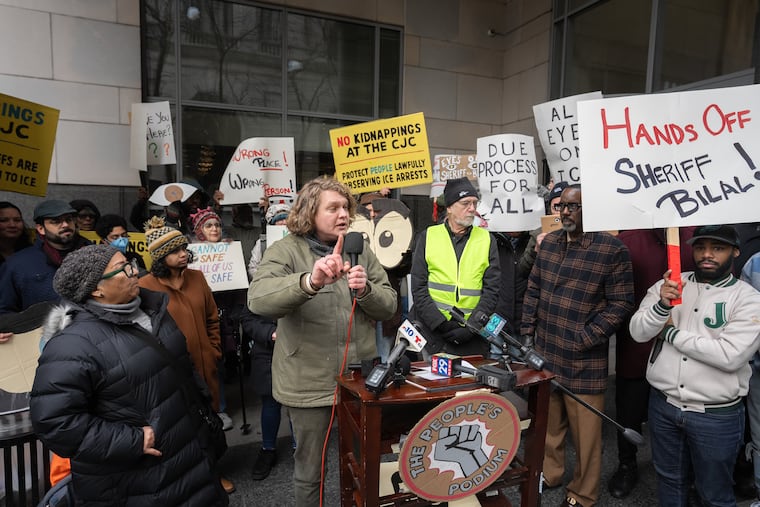
Protesters oppose ICE arrests at Philadelphia courthouse as supporters defend the sheriff against allegations of unfair blame.
Activists advocating for immigrant rights assembled outside the Criminal Justice Center in Philadelphia on Thursday, urging Sheriff Rochelle Bilal to clarify her stance on the presence of U.S. Immigration and Customs Enforcement (ICE) agents in the courthouse. The demonstration, organized by No ICE Philly, aimed to address the sheriff’s policies regarding immigration enforcement and its implications for community safety.
Bilal did not attend the protest, leading Aniqa Raihan, a prominent speaker at the rally, to highlight her absence by leaving the podium momentarily unoccupied, drawing attention to the lack of representation from the sheriff’s office. As Raihan resumed her remarks, she faced interruptions from counter-demonstrators, supporters of Sheriff Bilal, who contended that accusations against her were unjust. These supporters argued that the sheriff can only prevent ICE access to the courthouse with a judicial order, igniting a heated exchange.
Andy Pierre, a backer of Bilal and CEO of Fox & Lion Communication, expressed that the sheriff’s participation in the protest would detract from her administrative responsibilities. Meanwhile, Bilal’s supporters displayed signs imploring protestors to “Hands off Sheriff Bilal,” underscoring their belief that the immigration advocates were misplacing their blame.
Advocates from No ICE Philly assert that it is within Bilal’s authority to ensure that courthouse security prohibits ICE activities, arguing that she does not need to abide by any directives from Philadelphia judges. Activists reported that around 90 immigrants had been arrested outside the courthouse, following their court appearances, a trend they claim is facilitated by the sheriff’s policies. Recently, three additional arrests were made, intensifying concerns within the community.
In a statement issued before the protest, Bilal’s office reaffirmed her position against cooperating with ICE. The sheriff’s office emphasized its commitment to not assist in ICE operations and restricted deputies from colluding with federal enforcement in the courthouse, aspiring to protect the safety of all who interact with the judicial system.
Critics of Bilal contend that her inaction has made the courthouse a hostile environment for immigrants, undermining the function of the courthouse as a space for justice rather than enforcement. This controversial backdrop has led many advocates to call for a reevaluation of policies that allow ICE to position itself near courthouses, citing incidents where individuals seeking legal recourse have become targets.
The discussion over courthouse policies and ICE presence is not limited to Philadelphia; similar actions have been taken in other jurisdictions. Recent legislative movements in Connecticut have sought to restrict civil immigration arrests at courthouses, and in Chicago, a ruling has been made to bar ICE from apprehending individuals on courthouse premises. This discourse reflects broader concerns surrounding the intersection of immigration enforcement and access to justice in American legal contexts.
Amidst the ongoing protests, community leaders voiced their hopes for a more inclusive Philadelphia, stressing that the city should embody compassion rather than fear. As activists continue to scrutinize the sheriff’s office, the tension between immigrant rights advocates and ICE remains a contentious issue in local and national conversations regarding immigration policy.
The urgent need to address these concerns speaks to a larger narrative of how communities navigate the complexities of immigration enforcement amid calls for reform and justice.