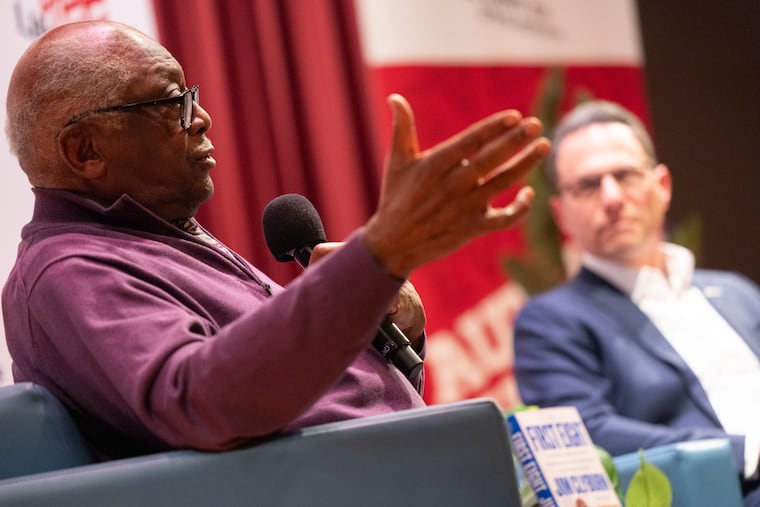
South Carolina Rep. Jim Clyburn discusses his new book with Governor Josh Shapiro.
When United States Representative Jim Clyburn of South Carolina assumed the role of majority whip, he reached out to the Library of Congress to obtain photographs of eight pioneering Black legislators. These images are now displayed prominently in his Washington, D.C., office. Clyburn recalls a moment when a group of visitors inquired about the identities of these men, who were, in fact, the first Black members of Congress from South Carolina. This moment prompted Clyburn to reflect on the significance of their histories, leading to the creation of his book, The First Eight: A Personal History of the Pioneering Black Congressmen Who Shaped a Nation.
Clyburn recently discussed this work with his longtime friend, Governor Josh Shapiro, during an event organized by the Free Library of Philadelphia. He emphasized that the book serves as a cautionary tale, alerting readers to the cyclical nature of history and the potential for the repetition of past injustices. Released in early November, Clyburn’s book chronicles the lives and contributions of South Carolina’s Black congressional representatives who served in the aftermath of the Civil War and Reconstruction. These individuals include Joseph Rainey, Robert De Large, Robert Elliott, Richard Cain, Alonzo Ransier, Robert Smalls, Thomas Miller, and George Washington Murray. Clyburn himself became the ninth Black member of Congress from South Carolina in 1992.
Combining historical narrative with personal memoir, The First Eight seeks to illuminate the contributions of these underrepresented figures while also reflecting on Clyburn’s extensive career in Congress. His intention is to create a lasting tribute to the legacy of these trailblazers, while also offering a critical examination of contemporary American politics.
Clyburn draws parallels between the tumultuous electoral history faced by these early Black legislators and modern political dynamics, including the January 6 insurrection at the U.S. Capitol and the rise of right-wing extremism. He connects historical events—such as the assassination of President Abraham Lincoln and the subsequent rise of Jim Crow laws—to the nearly century-long absence of Black representation from South Carolina in Congress.
As the conversation progressed, Clyburn noted significant modern political events, such as the recent gubernatorial elections in New Jersey and Virginia, and the mayoral election in New York City, suggesting they may indicate a glimmer of hope for progressive movements in the current political climate. He concluded by asserting the importance of history in shaping contemporary action, urging all to recognize their role in influencing future social and political landscapes.
Clyburn’s The First Eight not only aims to educate readers about the past but also serves as a guide for tackling the challenges facing the nation today.