
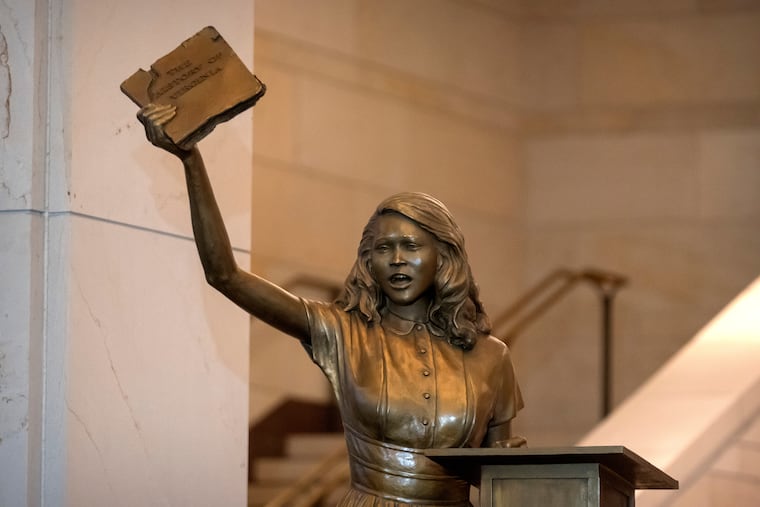
Statue of civil rights activist, who lived in Philadelphia, unveiled in the U.S. Capitol.
In a significant moment for civil rights recognition, a statue of Barbara Rose Johns has been installed in the U.S. Capitol, replacing a monument of Confederate General Robert E. Lee. This event marks a pivotal shift in how history is commemorated in American public spaces. Johns, a key figure in the American civil rights movement, led a pivotal 1951 walkout at her segregated high school in Farmville, Virginia, a protest that ultimately contributed to the U.S. Supreme Court’s historic decision in Brown v. Board of Education.
During a ceremony on Tuesday, House Minority Leader Hakeem Jeffries expressed that Virginia will now be represented by a figure whose legacy embodies the ideals of liberty and justice instead of a traitor who fought to maintain slavery. This unveiling highlights Johns’ significant role as a civil rights activist, despite her later life being largely spent in Philadelphia.
Born in New York City in 1935, Johns relocated to Virginia, where she attended Robert Russa Moton High School. Frustrated by the inadequate resources available to her all-Black school, she organized a protest that garnered the support of the NAACP lawyers. This led to the landmark case known as Davis v. Prince Edward, which became one of the critical cases reviewed in Brown v. Board of Education. The Supreme Court’s 1954 ruling ultimately deemed segregated public schools unconstitutional, although Prince Edward County’s schools would remain segregated until the mid-1960s.
Following the unrest after the walkout, Johns was sent to live with her uncle in Montgomery, Alabama, where she finished high school and began her higher education at Spelman College in Atlanta. In 1954, she married Rev. William Rowland Powell and later moved to Philadelphia, where she earned a degree in library science from Drexel University in 1979. Johns dedicated over two decades of her career to the Philadelphia School District as a librarian.
Johns passed away on September 25, 1991, after battling cancer. Her family remained largely unaware of her activism until late in her life. The statue serves as a part of the National Statuary Hall Collection, which allows each state to present a pair of statues. Virginia’s second representative in the collection is George Washington.
The decision to replace Lee’s statue reflects the changed national attitude towards Confederate symbols, particularly during the period of social reckoning following George Floyd’s death. In December 2020, a commission proposed replacing Lee’s statue with one honoring Johns. Notably, Johns is also commemorated in a sculpture at the Virginia Civil Rights Memorial, and her former high school is now a National Historic Landmark.
The installation of Barbara Rose Johns’ statue not only honors her contributions to civil rights but serves as a reminder of the ongoing struggle for equality in America.


