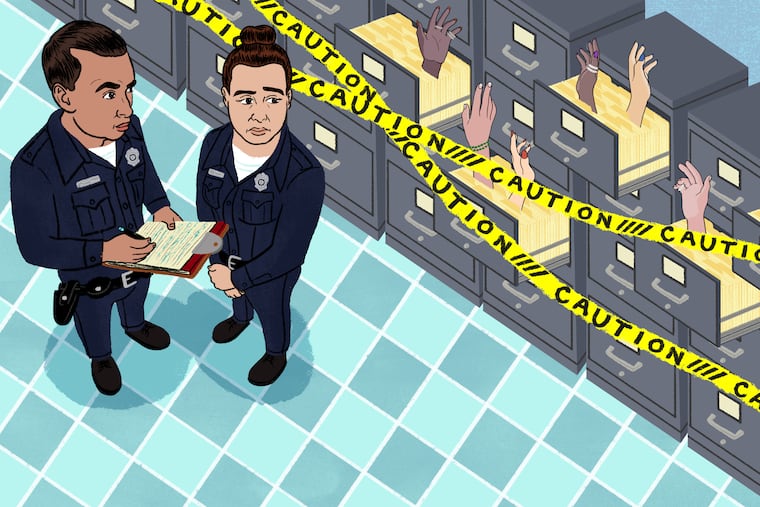
State College area sees hundreds of unreported rapes in public police data over nearly ten years.
Recent investigations have revealed significant discrepancies in the crime statistics reported by the State College Police Department in central Pennsylvania, raising concerns about the accurate representation of sexual assault incidents in the community. A detailed report by Media News Source indicates that from 2013 to 2021, the department reported only 67 rapes to the Pennsylvania State Police, a stark contrast to the 321 rapes that are believed to have actually occurred during that same period. This represents a startling discrepancy of 254 cases.
It has been found that many of these unreported rapes were instead categorized as sex offenses, which do not carry the same urgency or implications as rape in law enforcement terms. The police department has admitted that it relied on an outdated definition of rape until late 2022, despite federal guidelines established earlier in 2012 aimed at creating a more inclusive definition. This oversight persisted even as numerous police agencies across the nation adopted the updated standards following their introduction in 2013.
John Gardner, the current State College Police Chief, acknowledged that he was unaware of the changes to the FBI’s rape definition until 2022, when one of his records supervisors completed a training course that addressed the issue. Gardner and his predecessor, Tom King, who retired in 2016, indicated that they were not informed of this crucial change in reporting requirements. The admission has led to questions about the integrity of the data presented to the public and what other issues may exist within the department’s reporting processes.
The implications of inaccurate crime statistics are significant, particularly in a college town where many Pennsylvania State University students live off-campus. The federal law requires the university to report crimes that occur in designated areas surrounding the campus, which affects both the perception of safety in the community and the allocation of resources for law enforcement.
Experts suggest that trust between the community and law enforcement can deteriorate when crime statistics are perceived as unreliable, which may result in victims being less likely to report offenses. This underscores a broader concern about public safety and the proper handling of sexual assault cases.
Additionally, the Media News Source investigation uncovered multiple inconsistencies in how the department categorized and reported incidents of sexual violence. For instance, internal records indicated that crimes described as assaults in police reports often corresponded to actual rapes recorded by the department. Some cases, such as incidents involving multiple victims, resulted in underreporting because incidents were categorized based on the number of incidents rather than individual victims.
The findings highlight an urgent need for the State College Police Department to reevaluate its reporting processes and ensure compliance with established crime reporting guidelines to foster transparency and uplift community trust. As more of these discrepancies are disclosed, the challenge remains for the department to restore faith in its crime reporting and ensure that all victims receive the justice they deserve.