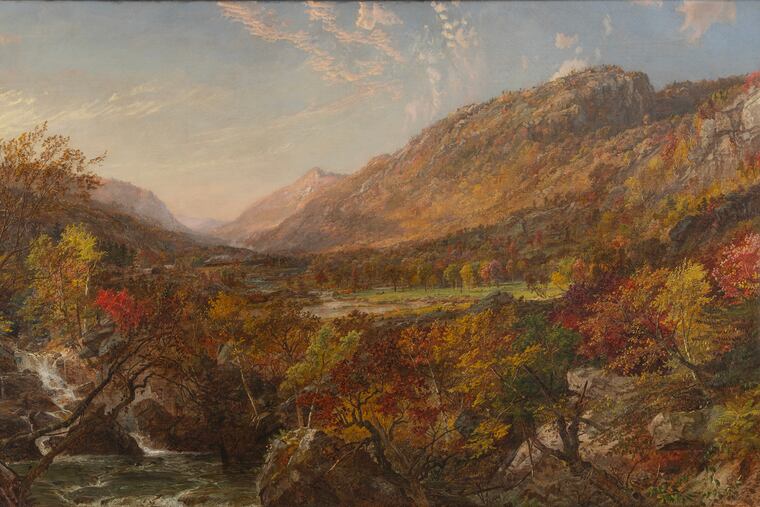
1873 Painting Displayed Publicly for the First Time in 152 Years
In September 1873, the New York Herald reported on a significant event in the art world: the unveiling of Jasper Francis Cropsey’s painting, Autumn in the Ramapo Valley, Erie Railway, which would be available for public viewing for just a short time at the Wall Street office of Charles Day. The work was commissioned by James McHenry, an influential railroad investor who was a director at the Erie Railway—a company established in 1832.
In a notable turn of events in 1827, McHenry staged a corporate takeover against the powerful railroad magnate Jay Gould. This victory not only marked his dominance in the Erie Railway but also led him to commission Cropsey for a commemorative painting. After its brief showing in New York, the painting migrated to McHenry’s private residence in London, subsequently remaining in obscurity for over a century.
In a recent turn of events in 2024, philanthropists J. Jeffrey and Ann Marie Fox acquired this long-lost masterpiece, successfully bringing it back to the United States. Currently exhibited at the Brandywine Museum of Art, the painting is on display for the first time in 152 years, approximately 150 miles from where it was originally created near Sloatsburg, New York.
The Foxes have a longstanding interest in American history and art. In 2024, the couple made a generous million donation to establish the J. Jeffrey and Ann Marie Fox Graduate School at Pennsylvania State University, reflecting their commitment to educational philanthropy. Over the years, they have curated their own art collection, with a particular affinity for purchasing significant American works. Their journey in art collection began with smaller pieces before they set their sights on obtaining a notable Cropsey work.
The discovery of Autumn in the Ramapo Valley coincided with a tip from an art advisor that the piece would be available at an auction in London. With limited time to act, the Foxes decided based on a photograph and condition report, understanding its cultural significance. According to the Newington Cropsey Foundation, the painting had eluded public view since it left the country in 1873.
A three-month process ensued to secure clearance for the painting to leave England, an obstacle that was navigated successfully due to its connection to American art. The Foxes acquired the painting in January 2025. Upon its arrival in the United States, art restorers confirmed its exceptional condition.
The work’s composition features a vibrant fall landscape characterized by richly colored foliage, underscored by the distant silhouette of a train, exemplifying the intersection of art and the burgeoning transportation industry of the 19th century. Cropsey, who was an architect and an artist, engaged with themes of progress, capturing the American experience through his landscapes.
Displayed at the Brandywine Museum as part of the exhibition “Cropsey, Wyeth, and the American Landscape Tradition,” this artwork invites viewers to reflect on a pivotal era in American art history. The painting will remain on exhibition until May 2025 before embarking on a nationwide tour, emphasizing its relevance in today’s dialogue about American identity and artistic heritage. The Foxes, with their dedication to making this work accessible, prioritize the story and significance of the painting over its financial valuation, committing it to a path of cultural enrichment.
For further details, “Cropsey, Wyeth, and the American Landscape Tradition,” continues through May 31 at the Brandywine Museum of Art, located at U.S. Route 1 at Hoffmans Mill Road in Chadds Ford, Pennsylvania.