
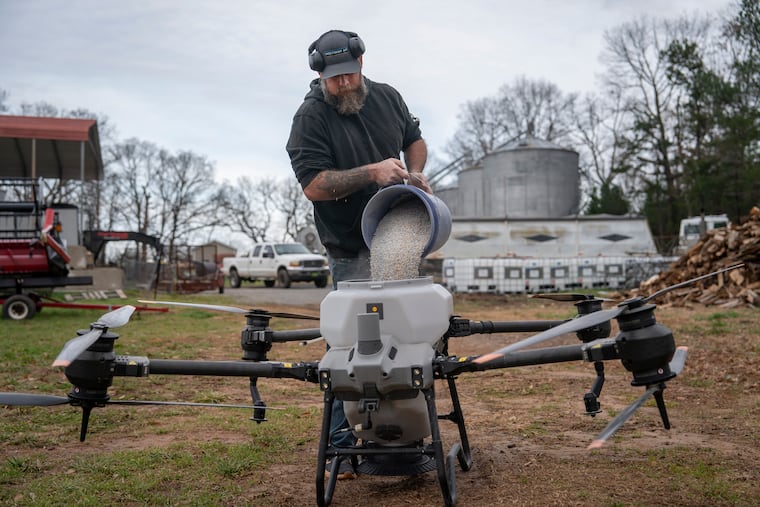
Advancements in technology make farming more appealing as a career option for young workers.
In Phoenix, Arizona, a revolutionary shift in agricultural practices is underway, significantly transforming the landscape of farming. A modern farm operated by Duncan Family Farms now utilizes an advanced AI-powered machine known as the LaserWeeder, developed by the start-up Carbon Robotics. This innovative device allows a single worker equipped with an iPad to efficiently manage weeding across vast vegetable fields that previously required up to 20 laborers performing manual tasks under the sun’s glare.
The LaserWeeder, affixed to a tractor, employs laser technology to identify and eliminate unwanted weeds, thereby enhancing the efficiency of farming operations. This technological advancement reflects a broader trend within the agricultural sector, where artificial intelligence (AI) is reshaping job roles and operational paradigms. The rise of AI technologies is enabling more sustainable farming methods—reducing water use and allowing for targeted application of pesticides and fertilizers—while simultaneously aiming to attract young workers back to an industry grappling with a demographic crisis.
Experts, such as Madhu Khanna, a distinguished professor at the University of Illinois, anticipate that the integration of AI will lead to the emergence of new job categories in agriculture. The character of farm work is evolving from labor-intensive tasks to roles focused on managing and overseeing robotic systems. This shift is critical, especially in light of recent statistics from the 2022 Census of Agriculture, which revealed that the average age of U.S. farmers is 58 years.
The movement toward precision farming, which began in the early 1990s, laid the groundwork for these advancements. By utilizing GPS, automation, and remote sensing, farmers can optimize crop yields while minimizing waste. According to Farmonaut, an agricultural technology company, approximately 60% of U.S. farms now leverage AI technologies, necessitating a workforce skilled in drone operation and automation engineering.
As agricultural producers face a significant labor shortage—an issue that has emerged as their foremost concern—innovative technologies may play a vital role in rejuvenating interest in farming careers among younger generations. Programs targeting high school students, such as those partnered with Washington State’s Future Farmers of America, aim to instill enthusiasm for agricultural technology. Many young people view the integration of drones, machine learning, and robotics as an enticing opportunity, contrasting with the perspectives of older generations.
While the benefits of AI in agriculture are clear, certain challenges accompany its expansion. The infrastructure supporting AI technology poses environmental risks, such as significant energy and water consumption. Data centers, which are crucial for sustaining AI operations, could potentially account for a substantial portion of global electricity use in the coming years.
Moreover, ethical considerations regarding job displacement, corporate consolidation, and data privacy concerns are becoming increasingly relevant. As industry leaders like Jordan Jobe note, establishing ethical frameworks for technology use is essential, even as the efficiency gains from AI are predicted to outweigh potential drawbacks.
As the global population is projected to reach nearly 10 billion by 2050, the urgency to enhance food production looms large. The Food and Agriculture Organization estimates that food production must increase by 70% within the next few decades, necessitating innovative solutions to counteract the challenges posed by a shrinking agricultural landscape and the impacts of climate change.
In summary, the evolution of technology in agriculture is a double-edged sword, promising increased efficiency and productivity while also raising significant ethical and environmental considerations. The agricultural sector stands at a crucial juncture, balancing the need for innovation against the imperatives of sustainability and social responsibility. The coming years will be critical in determining how these challenges are navigated as the industry embraces a technologically integrated future.


