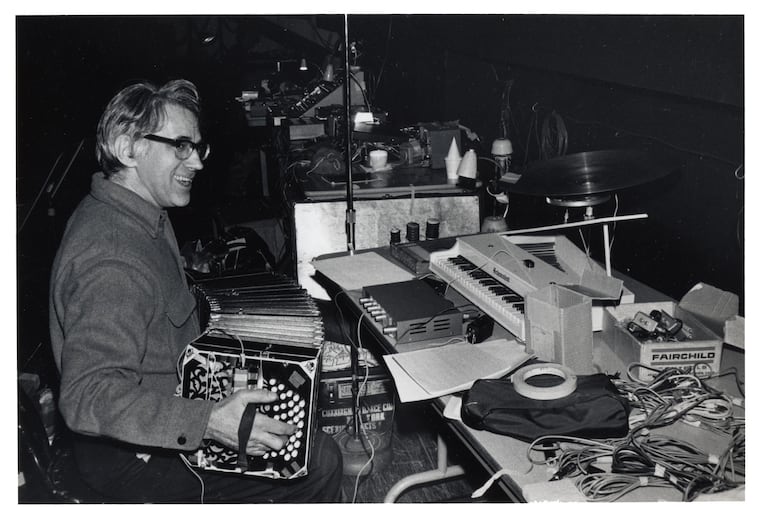
Man Creates Musical Instruments from Unconventional Materials, Including Glass Bowls, Trees, Buildings, and an Island.
David Tudor, a significant figure in American avant-garde music, was born in West Philadelphia in 1926. His early musical journey was remarkably typical for a prodigy, commencing with piano lessons at the tender age of six before shifting his focus to the pipe organ by age 11. By the time he reached his mid-teens, Tudor was regularly performing at various venues, including St. Mark’s Church in Center City and Trinity Episcopal Church in Swarthmore, as well as the well-known midday concerts at John Wanamaker’s department store.
However, as demonstrated by a recent concert of his works presented by Bowerbird at the Community Education Center, Tudor’s artistic trajectory became increasingly unconventional over his lifetime. During this event, a group of musicians emulated Tudor’s unique approach to music-making, operating from tables overflowing with an array of wires, knobs, and other unconventional items. This included objects such as glass bowls, a suspended box fan, an oversized die, and even a tree, all connected to transducers that amplified their natural resonances.
Even a century after his birth and three decades posthumously following his death in August 1996, David Tudor’s innovative compositions feel like they belong to a distant yet imaginative future. Long before the arrival of AI-generated musical acts like Velvet Sundown, which attracted over one million subscribers on streaming platforms, Tudor was experimenting with machine-learning concepts in the early 1990s, collaborating with engineers from Intel on the Neural Network Synthesizer.
Tudor’s musical evolution can be traced back to his engagement with contemporary classical composers following World War II, where he gained recognition as a pianist and collaborator for luminaries such as John Cage, Morton Feldman, and Earle Brown. His partnership with Cage, in particular, was instrumental as Tudor became a vital medium for conveying chance operations within Cage’s compositions.
A pivotal chapter in Tudor’s development unfolded at the Settlement Music School in South Philadelphia, where he studied under pianist Irma Wolpe. The Wolpe couple introduced him to modernist trends, igniting his creativity and leading him to challenge conventional music narratives. An ongoing exhibition at Drexel University’s Pearlstein Gallery titled “David Tudor: A View From Inside” further explores Tudor’s radical approach to composition, linking his innovative style to his early experiences in Philadelphia.
The pipe organ, an instrument enveloping the performer, deeply influenced Tudor’s musical philosophy. Curator Dustin Hurt remarks that Tudor’s process was less about dictating what music he wanted to create and more about discovering the innate capabilities of various instruments. This curiosity led composers to present Tudor with challenges, favoring inventive solutions over performances of established repertoire.
By the 1960s, Tudor had largely abandoned the piano in favor of modifying electronic devices to create unpredictable sonic landscapes. His commitment to exploring the indeterminacy of sound became evident as he constructed original instruments that reflected his creative vision. Tudor’s legacy is encapsulated in collaborations such as Stanley Lunetta’s “Piece for Bandoneon and Strings,” which integrates unique performance instructions tailored to Tudor’s innovative spirit.
Tudor’s creativity further expanded during Expo ’70, where he ingeniously transformed an entire building into an instrument, echoing his long-held ambition to merge the environment with music. Though a project to convert a whole island into a musical instrument would not be realized until 2024, Tudor’s influence continues to resonate, showcasing the enduring relevance of his contributions to the music world.
Currently on display, “David Tudor: A View From Inside” runs through March 21 at Drexel University’s Pearlstein Gallery. A testament to his profound impact on contemporary composition, this exhibition invites audiences to explore the mind of a musician whose insatiable curiosity and innovative spirit have left an indelible mark on modern music.