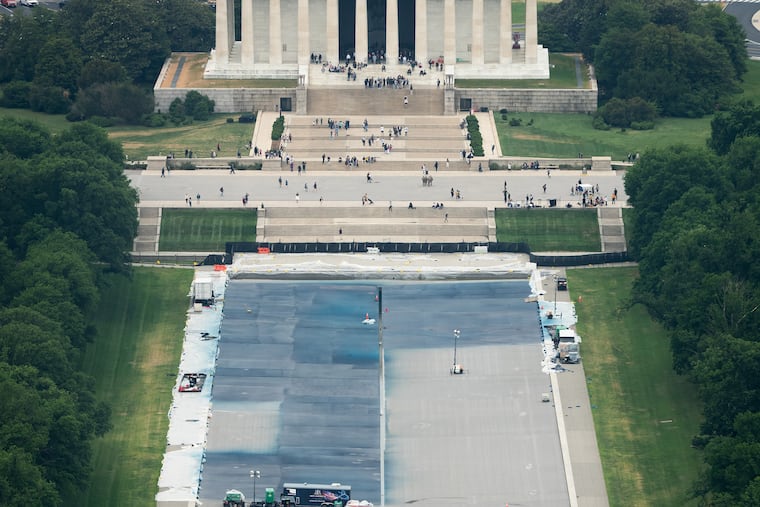
Washington’s Reflecting Pool Changes Color to Blue Due to No-Bid Contract
In a recent development, the Lincoln Memorial Reflecting Pool, a historical landmark in Washington, D.C., is undergoing significant alterations, led by the Trump administration. Initially constructed in 1922, the Reflecting Pool has served as a symbol of American history and resilience, reflecting key moments from Martin Luther King Jr.’s “I Have a Dream” speech to various national protests.
This spring, President Donald Trump announced plans to repaint the pool blue, directing a government contract to Atlantic Industrial Coatings, a company with which he has prior associations, particularly in relation to his private golf properties. The decision to repaint the iconic pool involves a substantial financial outlay of .9 million, a figure that has since been scrutinized for its lack of competitive bidding, typically a standard procedure in government contracts. The administration justified this no-bid contract by citing an exemption for urgent situations, although no significant threat to government finances was publicly articulated.
Critics of the administration’s approach argue that such contracts highlight a troubling trend, wherein government resources are allocated without transparent competition, often favoring the president’s personal associates. This practice raises concerns regarding governance and the fair distribution of federal contracts. Previous administrations had rarely invoked similar exemptions, which makes the recent developments notable within the context of federal contracting norms.
Moreover, experts have questioned the efficacy of the renovation plans, particularly in addressing longstanding issues with the pool’s infrastructure, including faulty plumbing in its filtration system. Critics emphasize that mere cosmetic changes, such as painting the pool, will not resolve underlying problems that have plagued the Reflecting Pool for years. The project has faced further backlash after it was reported that the repairs will only withstand seven to ten years of use, contrary to initial assurances of a lifespan extending up to fifty years.
Additionally, the project has raised eyebrows regarding regulatory compliance. Unlike past renovations that underwent thorough reviews by the Commission of Fine Arts, the Trump administration opted not to submit the new paint scheme for scrutiny, leading to speculation about the long-term impact these changes may have on the landscape integrity of the National Mall.
Experts within architectural and landscaping fields have expressed concern regarding how the changes, particularly the new blue hue, might alter the visual character of this significant memorial, potentially undermining its original purpose as a reflective and harmonious space amidst the nation’s monuments.
As the nation approaches critical commemorative events, the juxtaposition of this historic site with the current administration’s expedited renovation practices prompts broader questions about the preservation of America’s historical narratives and the integrity of its public spaces.
These changes mark a significant chapter in the ongoing story of the Reflecting Pool, whose surface reflects more than just the surrounding monuments; it also mirrors the evolving dynamics of governance and public accountability in contemporary America.
Media News Source