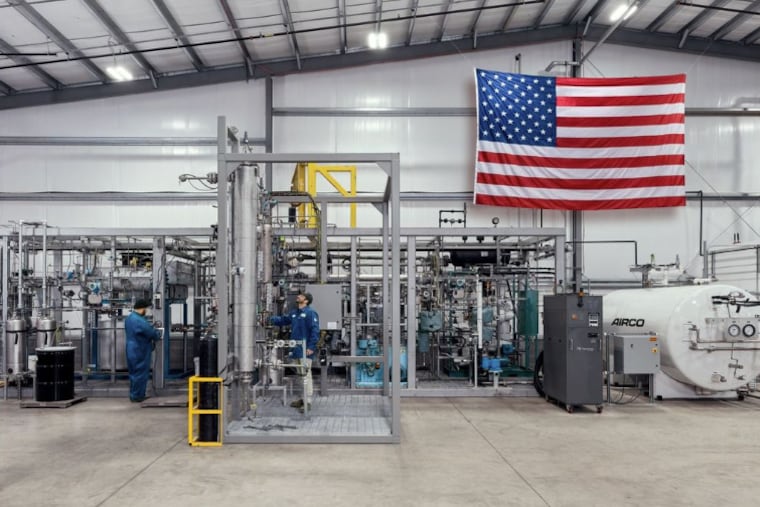
Airco opens new Bucks County factory to produce machines that generate jet fuel from air and electricity.
Airco, a company notable for its innovative development of portable systems that create jet fuel from water, carbon dioxide, hydrogen, and electricity, has officially relocated its manufacturing operations to a new facility in New Britain, a suburb of Bucks County, Pennsylvania. This strategic move aims to enhance the company’s production capabilities and streamline its operations by consolidating its research, development, engineering, and assembly processes under one roof.
Backed by significant private equity investments and governmental support, Airco has garnered substantial funding, including million from the U.S. military’s Defense Innovation Unit and million from the Air Force’s AFWERX innovation group. Furthermore, collaborations with prominent airlines such as JetBlue and Alaska Airlines, along with investments from Toyota Ventures, have amassed over 0 million in commitments to assist in the company’s initiatives.
The newly established 16,000-square-foot facility reportedly quadruples Airco’s manufacturing capacity compared to its previous locations. This expanded capacity is critical as the company focuses on assembling Mobile, Adaptable, and Dynamic (MAD) fuel-generation units intended for deployment to the Air Force and commercial airline markets. These innovative units are designed to generate fuel in diverse locations, provided they have access to electricity, thus aimed at reducing transportation costs and risks typically associated with conventional fuel distribution methods.
The MAD units represent a significant leap toward a more decentralized approach to fuel production, with the potential to redefine how aviation fuel is sourced and delivered. Airco’s chief executive, Gregory Constantine, has emphasized the facility’s role in facilitating the production of autonomous fuel generation systems capable of on-demand operations, marking a departure from traditional fuel as a mere commodity.
Despite the historical context of synthetic fuels—previously utilized in World War II—the current iteration is marked by advanced technological enhancements aimed at efficiency and cost-effectiveness. Airco’s approach includes the mass production of standardized fuel generation units, which could significantly reduce the costs associated with synthetic fuel production while making the technology more accessible and practical for widespread use.
The decision to establish the new plant in New Britain is not arbitrary; it reflects a careful consideration of local workforce availability and expansion potential. Bucks County, known for having a robust manufacturing presence, offers a skilled labor pool conducive to Airco’s growth ambitions, as it stands out with over 10% of its workforce engaged in manufacturing—a figure above the state and national averages.
As Airco positions itself at the forefront of renewable fuel technology, the implications of its operational expansion extend far beyond local manufacturing. The company’s advances may contribute significantly to the broader landscape of sustainable aviation fuel solutions, aligning with increasing global demand for environmentally friendly energy sources.