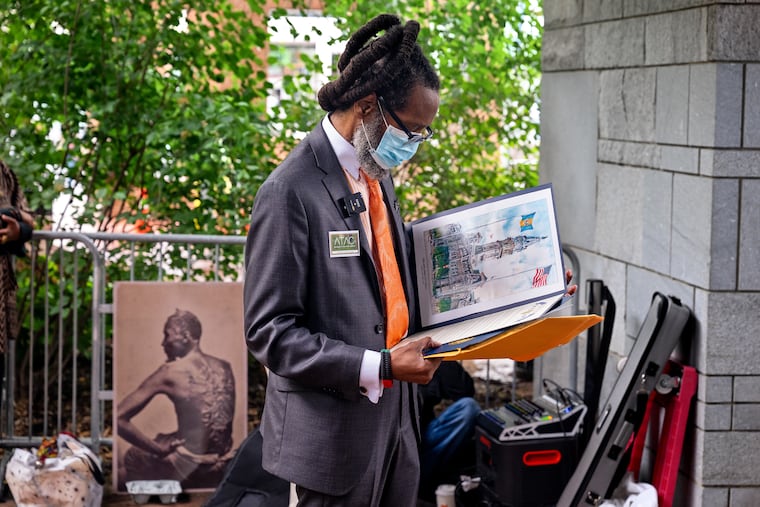
Philadelphia commemorates Ona Judge’s escape from slavery at the partially restored President’s House.
On May 21, a gathering at the President’s House on Independence Mall marked a significant commemoration led by Michael Coard, who has organized this annual pilgrimage for over twenty years. This date commemorates the moment in 1796 when Ona Judge, a young enslaved woman, made a daring escape from the household of George and Martha Washington.
Despite the inclement weather that marked this year’s observance, community members and supporters came together to honor Judge’s bravery. Their gathering, however, took place against a backdrop of change—namely, the removal of the exhibit that previously highlighted Judge’s story and those of the eight others who were enslaved by Washington. The exhibit, which was considered a vital part of the interpretive narrative of the President’s House, was abruptly dismantled during the Trump administration, leaving behind an incomplete representation of this important historical context.
In a positive albeit contrasting development, Mayor Cherelle L. Parker recently proclaimed May 21 as “Ona Judge Day.” This executive order aims to enhance public awareness of Judge’s legacy and her extraordinary act of defiance. Parker’s declaration follows a resolution approved by the City Council in April, further emphasizing the significance of Judge’s story in the context of Philadelphia’s complex history with slavery.
Councilmember Cindy Bass, who played a pivotal role in the resolution’s introduction, spoke at the gathering, urging the community to educate younger generations about Judge’s courage and the broader historical implications of her life. For many participants, including Coard, Judge’s story is a source of both inspiration and outrage, particularly regarding the lack of educational resources about slavery in Philadelphia, historically viewed as America’s birthplace.
Born around 1773 on George Washington’s plantation in Mount Vernon, Ona Judge served as a personal attendant to Martha Washington. While in Philadelphia, she found herself subject to Washington’s attempts to evade Pennsylvania’s gradual abolition law. In a calculated move, Washington rotated his enslaved workers back to Virginia every six months to maintain control over them.
In the spring of 1796, Judge learned that she was to be given as a wedding gift to Martha Washington’s granddaughter, heightening her resolve to escape. Seizing an opportunity when the Washingtons were dining, she fled and ultimately settled in New Hampshire, where she lived under the persistent threat of recapture.
Despite the Washingtons’ relentless pursuit, Judge remained free until her death in 1848, outliving both George and Martha Washington by 50 years, a fact that Coard emphasized during the commemoration.
The President’s House site presently faces challenges in accurately conveying its history. This year, it was listed among the National Trust for Historic Preservation’s “11 Most Endangered Historic Places,” a designation intended to elevate awareness regarding historic sites at risk of being overlooked or altered.
As legal disputes continue regarding the full restoration of the erased exhibits—following a federal judge’s ruling in favor of the city’s efforts—the community’s dedication to preserving and enlightening future generations about the history of slavery remains unwavering. While the National Park Service has begun restoration efforts, uncertainty lingers as the legal proceedings unfold, with a hearing set for June 2.
The ongoing discussion around the President’s House illustrates a broader struggle to reconcile historical narratives, revealing the critical need for transparency in how such histories are presented and interpreted.