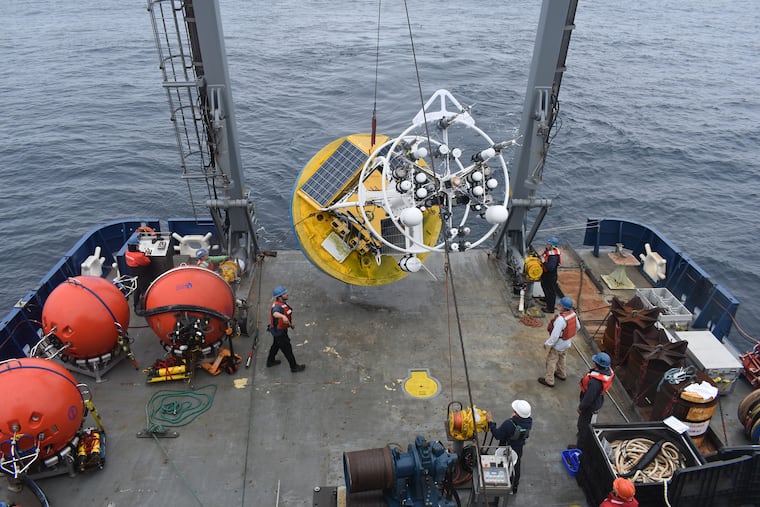
Trump administration plans to dismantle ocean monitoring system, impacting environmental oversight and data collection efforts.
The Trump administration has initiated the dismantling of a significant deep-ocean observation system, a project that was established a decade ago to monitor critical coastal environments, marine ecosystems, and ocean currents, all of which play vital roles in influencing global climate patterns. The National Science Foundation (NSF) has announced plans to remove over 900 deep-sea instruments anchored along the coasts of Oregon, Washington, Alaska, North Carolina, and in the Irminger Sea, situated between Greenland and Iceland.
The data collected from this network has been invaluable to scientists studying how oceans absorb greenhouse gases, the implications of rising ocean temperatures—especially concerning marine heat waves—and their potential impacts on fisheries and coastal flooding in the Eastern United States. The observations from the Irminger Sea have been critical in understanding the Atlantic Meridional Overturning Circulation, a crucial global water current that is increasingly at risk due to climate change. Disruption or collapse of this current could lead to severe weather consequences.
These moorings, anchored at depths of 9,200 feet, form part of an international scientific collaboration focusing on the dynamics of ocean circulation and climate interactions. The Ocean Observatories Initiative, as this network is known, has been described by experts as one of the most advanced ocean monitoring systems.
Michael England, a spokesperson for the NSF, has indicated that the decision to dismantle the system is part of a broader strategy aimed at ensuring the agency’s funding aligns more closely with evolving scientific priorities and emerging technologies. Critics, including Craig McLean, a former acting chief scientist at the National Oceanic and Atmospheric Administration, argue that this move reflects a profound misunderstanding of the value of scientific research and its implications for global scientific leadership.
This observation network, which began operations in 2016, was designed for a lifespan of 25 years, and its annual operational cost of million is deemed minor compared to the significant insights it provided into oceans and climate systems. Despite efforts to secure funding in the face of repeated attempts by the administration to cut its budget, the system is now being dismantled.
The process of removing these instruments is expected to extend over the next 15 months, and notable scientific figures have raised concerns over the potential loss of expertise and data continuity that such a dismantling entails. Hilary Palevsky, an earth and environmental sciences professor, argues that the decision to withdraw the instruments without a clear plan for data retrieval or future monitoring is hasty and detrimental to ongoing climate research.
In summation, the discontinuation of the Ocean Observatories Initiative reflects broader themes within U.S. scientific funding and research priorities at a time when understanding ocean dynamics is more crucial than ever in the context of global climate change. The implications of this decision on both national and international scientific collaboration remain to be seen as the world grapples with the pressing challenges of environmental transformation.