
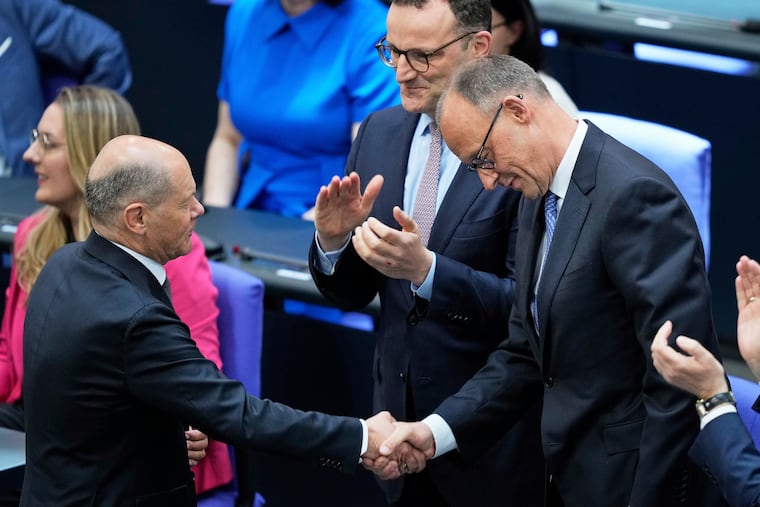
Friedrich Merz becomes Germany’s chancellor after winning on the second ballot following a historic defeat earlier in the day.
In a dramatic turn of events in German politics, Friedrich Merz has successfully assumed the role of Chancellor, eliciting reactions of relief and applause within the Bundestag. His election marks a pivotal moment for Germany, a nation that holds significant influence as the most populous member state of the European Union and the continent’s largest economy. Merz’s victory follows a tumultuous first round of voting, in which he fell short of the required majority, garnering only 310 votes in the initial ballot. This marked a historic moment in postwar German history, as no other candidate had previously encountered such a setback in a first ballot.
The ramifications of this unexpected defeat were felt immediately, affecting not only the political landscape but also the financial markets. The DAX, Germany’s benchmark stock index, experienced a notable downturn, dropping by as much as 1.8%. Nevertheless, Merz regrouped for a second round of voting several hours later, clinching 325 votes, which exceeded the 316 needed to secure the chancellorship in the 630-seat parliament.
While the first round’s outcome raised questions regarding party loyalty and unity, it ultimately underscored the challenges facing Merz’s coalition, which comprises the center-right Christian Democratic Union (CDU) and its Bavarian counterpart, the Christian Social Union (CSU), in addition to the center-left Social Democrats led by outgoing Chancellor Olaf Scholz.
Merz’s coalition faces pressing issues ahead, including revitalizing an economy that has shown signs of stagnation and addressing the rising influence of the far-right Alternative for Germany (AfD) party. The context of this transition is enriched by the geopolitical backdrop of the ongoing conflict in Ukraine, with Germany positioned as the second-largest supplier of military assistance to the country after the United States.
The recent vote coincided with the 80th anniversary of Nazi Germany’s surrender in World War II, a reminder of the historical weight that Germany carries as it navigates contemporary challenges. As President Volodymyr Zelenskyy of Ukraine has indicated, there exists a crucial need for robust leadership from Germany in both European and transatlantic contexts.
Germany’s military expenditure has soared, positioning the country as the fourth-largest defense spender globally. This surge is fueled by a significant investment of 100 billion euros (approximately 7 billion) directed toward military enhancement, a measure enacted by the Bundestag in 2022. The amplified focus on defense spending has garnered considerable attention across Europe, especially amidst uncertainties surrounding U.S. defense commitments.
Domestically, the political landscape remains complex. The AfD, which has emerged as the leading opposition party, was notably excluded from coalition negotiations due to the longstanding principle among Germany’s major political entities to resist alliances with far-right factions. Despite this exclusion, the AfD’s rising prominence has prompted the domestic intelligence service to classify it as a right-wing extremist organization, increasing its surveillance scope.
In light of these developments, Merz’s leadership will be closely scrutinized not only for its immediate impact on domestic governance but also for its potential implications on European stability and international relations. The dynamics of coalition politics, public sentiment, and the wider geopolitical context will undoubtedly shape the trajectory of Merz’s chancellorship in the months to come.


