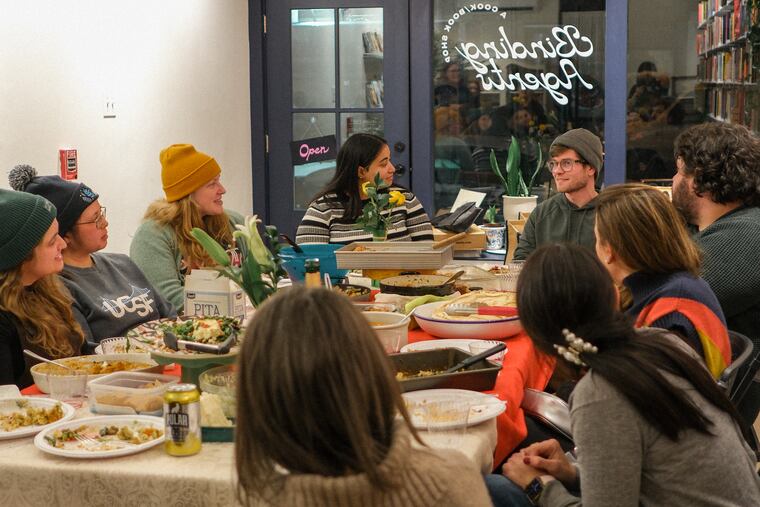
Philly’s only cookbook store hosts a unique book club combining discussions with potluck meals.
On a notably warm Sunday evening in March, Daryl Chen served a bowl of japchae—Korean sweet potato noodles—at Binding Agents, a cookbook store located in Philadelphia’s Italian Market. As she unveiled the dish, a family-sized serving, it quickly attracted attention from fellow attendees.
At 55, Chen expressed her joy in cooking during what she characterized as a challenging time politically and personally, particularly as many are finding it difficult to secure employment. She elaborated on the satisfaction of preparing a meal that resonated with her, offering a temporary respite from current struggles.
On that same evening, a roundtable discussion took place featuring Caroline Choe, the author of the cookbook “Banchan.” Chen humorously produced a Y-peeler from her bag, prompting laughter as she discussed its usefulness in preparing one of the recipes. She emphasized the importance of practical kitchen tools to enhance the cooking experience.
The Binding Agents cookbook club, convened by store owner Catie Gainor, is among numerous book clubs flourishing throughout Philadelphia. Each monthly gathering invites home cooks to prepare dishes inspired by the selected cookbook. Since its inception in January, the club has highlighted works such as Özlem Warren’s “Sebze,” Hetal Vasavada’s “Desi Bakes,” and Melissa Clark’s “Dinner: Changing the Game.”
Gainor initially envisioned hosting a cookbook club upon opening Binding Agents, noting a recent surge in such groups, especially as social gatherings regained popularity post-pandemic. She describes these events as a unique way for culinary enthusiasts to come together. Attendance at these gatherings has surged since the club launched, often resulting in waiting lists due to the limited capacity of 20 participants per event.
The pandemic sparked a notable increase in cookbook sales, with a reported rise of approximately 16% during its initial year. This trend remains steady as culinary literature not only fuels a passionate home-cooking culture but also adapts to the evolving needs of the public. Gainor attributes this sustained interest to a changing relationship with cookbooks, influenced by the accessibility of recipes online.
The club’s themes are shaped by the seasons and the moods of participants rather than adhering strictly to new releases. For instance, in February, the focus was on sweets, connecting with the month’s spirit without being confined to a Valentine’s Day theme.
Each event encourages participants to contribute a dish, employing a sign-up system to ensure varied offerings. Recent gatherings at Binding Agents have seen attendees engage eagerly, sharing stories and insights about their cooking experiences.
For many, like regular attendee Pat Feehan, preparation can be both a pressure and a pleasure, as he reflected on the importance of presenting a quality dish to share with the group. Meanwhile, others, like Dana Levy, find the community aspect invaluable, particularly as a newcomer to Philadelphia. For Levy, the cookbook club fosters connections with individuals who share an affinity for food and cooking.
Choe, the author, described the experience as fulfilling both creatively and personally, highlighting how such community events validate the efforts and emotional investments of culinary writers and enthusiasts alike.
As cookbook clubs continue to thrive in various communities, they seem to embody not just the art of cooking, but also the potential for cultural exchange and social connection amidst a hectic world.
Media News Source