Philadelphia Orchestra’s performance of ‘Tristan und Isolde’ lasts five hours and is considered a significant success.
Wagner’s monumental opera Tristan und Isolde graced the Philadelphia Orchestra’s stage for the first time since 1934, delivering a landmark experience that captivated audiences during its five-hour performance at Marian Anderson Hall. This ambitious production, conducted by Yannick Nézet-Séguin, reflects the complexities inherent in staging Wagner’s work, which often demands exceptional circumstances for its realization.
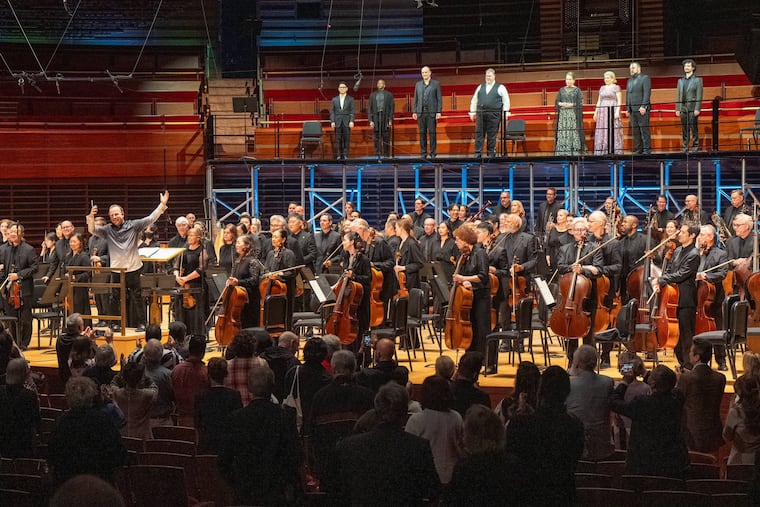
Historically, renowned conductors such as Leonard Bernstein and Carlos Kleiber have attempted to tackle Tristan, unrestrained by the opera’s substantial demands. However, the Philadelphia Orchestra’s recent presentation emerged as a considerable achievement, showcasing a diverse cast and well-prepared chorus. The orchestra’s presence dominated the space, with the typical “Conductor’s Circle” expanded to accommodate the large ensemble.
Despite noticing audience attrition nearing the fourth hour, the concert maintained a sense of engagement, illustrating the community’s desire for in-depth Wagner presentations. This performance could be seen as a precursor to Nézet-Séguin’s upcoming full production at the Metropolitan Opera next season; however, the Philadelphia Orchestra set a bar that may prove difficult for the esteemed New York institution to match.
While excerpts of Tristan are often performed, the entire piece remains an uncommon favorite among general audiences due to its narrative simplicity. The story chronicles the tragic love between Tristan and Isolde, whose union is born from a love potion, leading to betrayal, separation, and ultimately their demise. The opera explores themes of love transcending mortal boundaries, culminating in Isolde’s poignant aria, the “Liebestod,” which Wagner describes as transcending to a state of clarity.
The performance featured minimal cuts, with the most significant being a brief omission just prior to the Act II “Love Duet.” This conservative approach allowed for an uninterrupted immersion into Wagner’s complex sound world, characterized by a labyrinthine harmonic structure that extends the emotional landscape of the opera.
Nézet-Séguin’s interpretation exhibited a slow and monumental tempo in the opening, creating opportunities for heightened tension in subsequent passages, reflecting the depths of Wagner’s orchestration and vocal demands. As Tristan und Isolde often requires mastery in vocal performance, soprano Nina Stemme’s portrayal of Isolde was particularly noteworthy. Despite her announcement to retire from the role, she delivered a compelling performance marked by a powerful sound and refined vocal color.
Stuart Skelton, while not the most commanding Tristan, impressed with his clean vocal delivery, especially during the challenging Act III scenes. The supporting cast also showed promise, with Tareq Nazmi’s performance as King Marke resonating deeply with the audience, showcasing the complex emotional layers in the character’s arc.
The Philadelphia Symphony Chorus, prepared by Donald Palumbo, demonstrated remarkable precision and enthusiasm, further lifting the overall quality of the production. The performance of Tristan und Isolde is anticipated to resonate within the community, and calls for a return engagement are surely in order as audiences yearn for further exploration of Wagner’s rich orchestral palette.
This remarkable presentation of Tristan und Isolde will be repeated on June 8, 2024, at the Kimmel Center, providing another opportunity to experience this monumental work in its fullest form.
For more details on this event, visit Media News Source.