
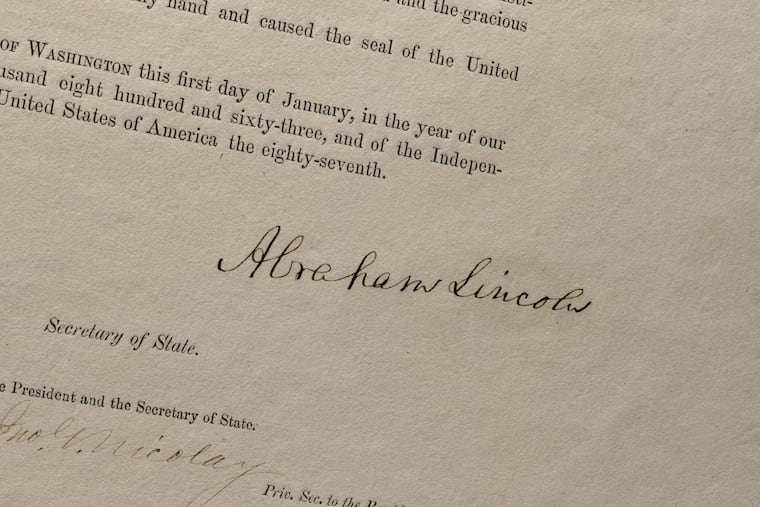
A signed print of the Emancipation Proclamation linked to Philadelphia will be auctioned.
In the aftermath of the Civil War, a significant historical artifact linked to President Abraham Lincoln’s Emancipation Proclamation is poised to go under the hammer next month. This year marks less than a century and a half since Lincoln signed the proclamation, which initiated a pivotal shift in American society by declaring the freedom of enslaved individuals in Confederate states.
In 1864, two Philadelphians, Charles Godfrey Leland, a veteran of the Battle of Gettysburg, and George Henry Boker, a prominent member of the Union League of Philadelphia, took steps to raise funds for Union soldiers and their families. Their initiative involved printing the Emancipation Proclamation in Philadelphia, making it accessible while also mobilizing financial support for those impacted by the war. With Lincoln’s endorsement, they produced 48 signed copies, each sold at – a sum equivalent to about a week’s wages for a laborer at that time.
Currently, only 27 copies of what is known as the Leland-Boker broadside remain, making this artifact exceptionally rare. One of these copies is set to be auctioned by Christie’s during its “We the People: America at 250” event in New York on January 23. The piece is estimated to sell for between million and million.
The broadside carries the signatures of both Lincoln and William Seward, Lincoln’s Secretary of State, along with John Nicolay, his personal secretary. Its historical significance is underscored by Peter Klarnet, a senior specialist in Americana at Christie’s, who emphasizes that despite the proclamation not conclusively ending slavery, it served as a crucial precursor to the 13th Amendment. The document symbolizes an evolution in American ideologies surrounding freedom and civil rights.
Both Leland and Boker were born into affluent families, educated at Princeton, and became keen writers with a lasting societal impact. Their collaboration is believed to have sparked during their involvement with the Great Central Fair, an event in 1864 designed to raise over million for the Union effort—a fair attended by Lincoln himself.
This auction is not solely a reflection of the significance of the Emancipation Proclamation but also highlights the broader historical context of American social changes over time. With only a handful of the signed broadsides remaining in private collections, the upcoming auction represents a unique opportunity for collectors to acquire a piece of American history, particularly amid commemorations of the nation’s Semiquincentennial.
The auction will also feature other historically significant items—including an edited draft of the U.S. Constitution and a letter from Benjamin Franklin—further emphasizing Philadelphia’s critical role in the formation of American democracy. The Leland-Boker broadside stands out, however, as an artifact that encapsulates the struggle for liberty and the profound implications of Lincoln’s leadership during a tumultuous period in American history.
This unique piece was previously owned by Philip D. Sang, a corporate executive in Chicago, and its current owner is the Gilder Lehrman Institute of American History, which plans to use the proceeds from the sale to bolster its acquisition and care funds. As this auction approaches, collectors and historians alike await a moment that underscores both the tangible and intangible legacies of liberty in America.
Media News Source


