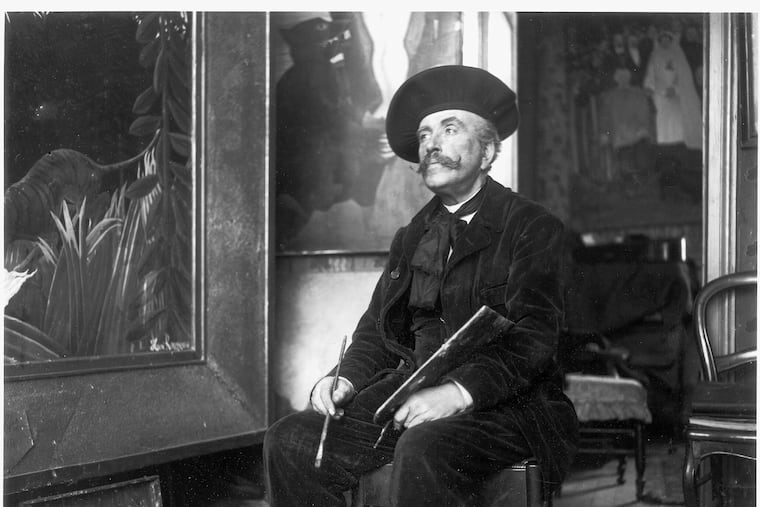
Albert C. Barnes founded one of the largest collections of Henri Rousseau’s artwork, highlighting the artist’s authentic approach.
The works of Henri Rousseau (1844-1910), a self-taught French artist, captivate audiences with their vivid imagery and imaginative compositions, often featuring exotic jungle scenes, wild animals, and human figures. Despite facing substantial hurdles, including a criminal background concerning embezzlement and bank fraud, Rousseau’s steadfast dedication to his craft has secured him a place in art history as an iconic figure.
Lacking formal art education, Rousseau articulated a belief that he was a significant artistic talent deserving of recognition. This belief was bolstered by a unique career trajectory that began when he retired in 1893 at the age of 49 with a modest pension, allowing him to pursue painting full-time. His works exhibit characteristics common to those trained outside traditional academic structures, including anatomical inaccuracies, flatness, and a distinct distortion of scale, underscoring an artist’s journey through an unorthodox lens. His piece “Tropical Landscape — An American Indian Struggling with a Gorilla” (1910) exemplifies the merging of fact and fantasy that defines his work.
The Barnes Foundation currently hosts “Henri Rousseau: A Painter’s Secrets,” an exhibition curated by Nancy Ireson and Christopher Green, featuring 56 pieces, including significant loans from various Parisian museums. Organized thematically, the exhibition aims to illuminate Rousseau’s transformation from an outsider to a modern master of art, reflecting on both the creative process and the inherent meaning behind his iconic artworks.
Rousseau’s work significantly impacted the avant-garde movement, with figures like André Breton acknowledging the importance of his visionary style. Strikingly, a parallel exhibition at the Philadelphia Art Museum titled “Dreamworld: Surrealism at 100” fails to acknowledge Rousseau’s invaluable contributions to surrealism, despite thematic similarities in their exploration of imagination and dreamlike scenarios.
Albert C. Barnes, a prominent modern art collector, recognized Rousseau’s artistic prowess, acquiring 18 of his paintings, thus establishing the world’s largest collection of Rousseau works. His appreciation for Rousseau’s approach as “honest” set the stage for broader recognition posthumously. The exhibition’s pièce de résistance consolidates three of Rousseau’s essential pieces for the first time: “The Sleeping Gypsy” (1897), “Unpleasant Surprise” (1899-1901), and “The Snake Charmer” (1907), which transitioned into the Louvre in 1936, finally providing Rousseau the recognition he sought during his lifetime.
Rousseau’s unique compositions, meticulously crafted in his Parisian studio, reflect a world he never physically visited, drawing inspiration primarily from imagery acquired through postcards and photographs. Despite his challenges, including a suspended sentence stemming from a bank fraud case in 1907, Rousseau’s fantastical jungle paintings continued to gain acclaim, influencing contemporaries like Pablo Picasso, who purchased “The Portrait of a Woman” (1895) and celebrated Rousseau’s imaginative vision.
The legacy of Henri Rousseau endures, encapsulated within the ongoing Barnes exhibition that runs through February 22, 2025. This glimpse into his artistic secrets and journeys attests to the enduring power of creativity unfettered by convention.
Visitors can also explore the Philadelphia Art Museum’s “Dreamworld: Surrealism at 100,” open until February 16, 2025.