
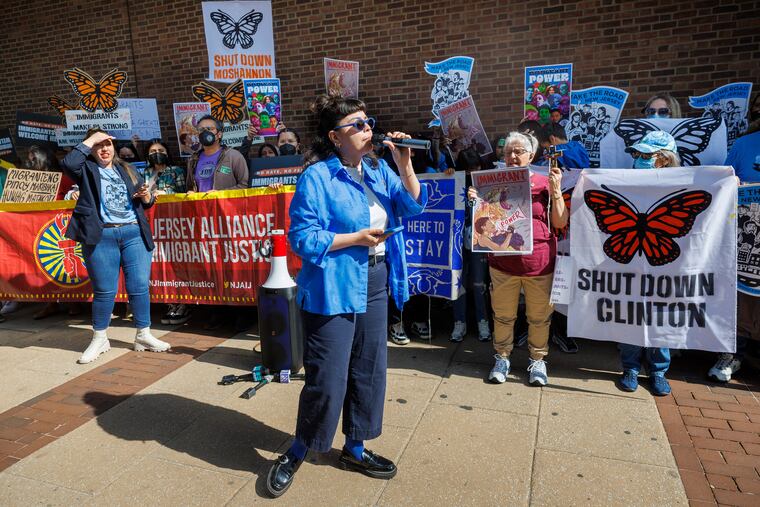
Appeals court reviews New Jersey ban on ICE detention-center contracts while protests occur in Philadelphia.
Outside the federal courthouse in Philadelphia, a gathering of voices marked a significant moment in the ongoing debate over immigration detention policies in the United States. Activists and supporters convened to advocate for the restoration of a New Jersey ban on immigration-detention contracts as the U.S. Court of Appeals for the Third Circuit began hearing the case. The legal proceedings come amidst a nationwide discourse on the treatment of immigrants, particularly as many detained individuals have no prior criminal records.
The rally saw approximately 150 participants from around 40 pro-immigrant organizations from Pennsylvania, New Jersey, and New York. Among them was college student Sol Acabo, who articulated the need for support for individuals facing detention, expressing a commitment to use his educational privilege to advocate for those unable to do so. Attendees emphasized the inhumane conditions at immigration-detention facilities, with organizers labeling them as “concentration camps.” Emily Lúa-Lúa, a youth organizer at Make the Road Pennsylvania, voiced the belief that detaining individuals does not contribute to community safety but rather disrupts families and neighborhoods.
The roots of the legal contention date back to 2021 when New Jersey Governor Phil Murphy enacted legislation prohibiting state and local entities from entering into contracts with Immigration and Customs Enforcement (ICE) for the detention of immigrants. This law was hailed as a milestone for immigrant rights, leading to the closure of three county-run detention centers. However, private prison firm CoreCivic challenged the legislation, claiming it impeded federal immigration enforcement. A 2023 ruling from a federal judge allowed the state to restrict public contracts but upheld the right of private companies to continue these arrangements.
Currently, CoreCivic operates the only immigration detention facility in New Jersey, located in Elizabeth, housing around 285 migrants daily. The company has maintained that its role is to assist the federal government in managing immigration challenges, countering assertions about the humanitarian impact of such operations.
Proponents of the New Jersey law, represented by legal counsel Jeremy Feigenbaum, assert that the state has a right to regulate immigration enforcement within its jurisdiction. Activists remain concerned, noting that fears of ICE intervention deter some undocumented individuals from participating in demonstrations, potentially impacting the breadth of public support for their cause.
The continued conversation around immigration detention in New Jersey is set against a backdrop of potential expansions in the state’s capacity for detaining immigrants, with plans for a new 1,000-bed facility in Newark. This situation reflects broader national trends, where about 48,000 immigrants are currently held in detention across the country, with approximately 46 percent having no criminal background.
Engaging deeply with the implications of these policies, local leaders, including Newark’s Mayor Ras Baraka, have expressed opposition to further ICE expansion in the city, citing the possible negative effects on health and community dynamics. This debate is likely to evolve as the federal government continues to pursue various strategies for managing immigration enforcement, prompting ongoing discussions about the intersection of federal policies and state-level advocacy for immigrant rights.
The outcome of this legal case could set a precedent not only for New Jersey but also for similar efforts nationwide seeking to redefine the role of immigration detention in community and state affairs.


