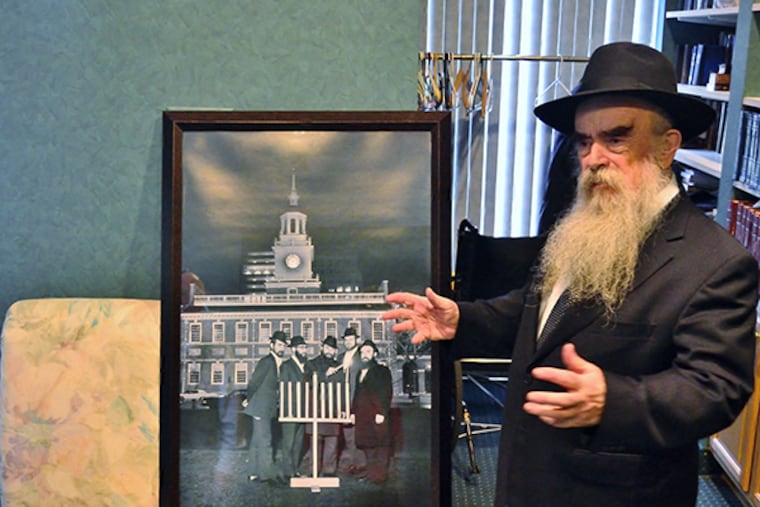
First public menorah lit on Independence Mall this week in Philadelphia history.
In December 1974, a significant milestone in the public celebration of Hanukkah took place outside the historic Independence Hall in Philadelphia. On December 14, a group of four men from the Lubavitcher sect of Hasidic Judaism, including the well-regarded Rabbi Abraham Shemtov, gathered on Independence Mall to light a menorah, marking what is believed to be the first public menorah illumination on government property.
As Rabbi Shemtov and his companions ignited the candles, they initiated a tradition that has since flourished in communities across the globe. Over the past few decades, the lighting of public menorahs has become a widespread phenomenon, symbolizing the Jewish celebration of light overcoming darkness and embodying the themes of perseverance, faith, and freedom. While Hanukkah, the Festival of Lights, may not hold the status of the most prominent Jewish holiday, its essence resonates deeply during the winter months, paralleling various cultural observances of light during the solstice.
Historically, the reluctance to light menorahs outside was rooted in practical concerns, primarily that outdoor flames were prone to extinguishment. However, that breezy December evening proved to be fortuitous: the menorah remained lit, serving as a sign of hope and resilience. Jewish tradition generally requires the menorah to be displayed at home, positioned at the threshold shared with the outside world, where it can emit its light for all to see.
The revolutionary act of publicly lighting the menorah that night has since inspired an expansion of this practice, with public menorahs now appearing in locations such as Revolution Square in Moscow and outside the White House in Washington, D.C. The initial ceremony in Philadelphia has been heralded as foundational, establishing a template for public menorah lighting that resonates within the global Jewish community.
Previously, the lighting of menorahs often took place in private settings, at times necessitated by social or political pressures. Rabbi Shemtov recalled the intimate nature of the gathering, highlighting that although the menorah lighting was a public event, it retained a personal character. Over the years, this significant act of visibility has transformed into a celebratory occasion that fosters communal joy, conveying the enduring message of hope intrinsic to the Hanukkah narrative.
As public menorahs become increasingly common, they serve not only as a reminder of Jewish heritage but as symbols of cultural exchange and acknowledgment in increasingly diverse societies. The event in Philadelphia in 1974 marked the beginning of a journey that continues to illuminate communities worldwide during the festive season. Media News Source.