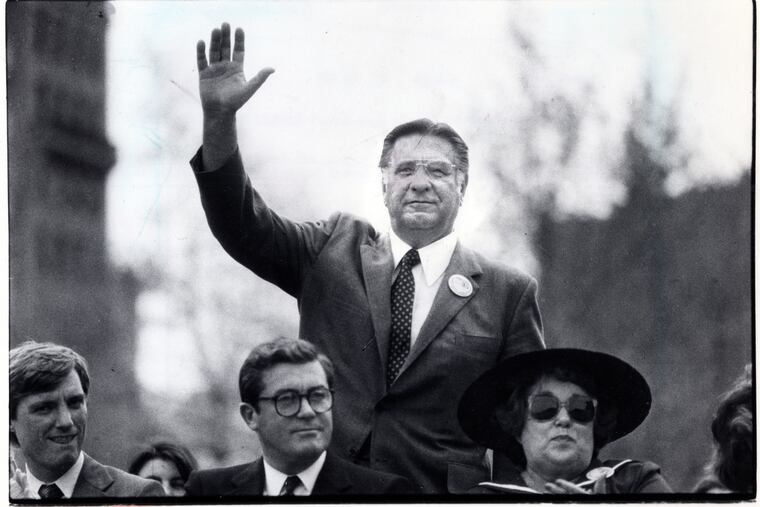
Frank Rizzo’s ‘crumb bum’ remark to a reporter featured in this week’s Philadelphia history highlights.
In a significant moment from Philadelphia’s media history, a reporter for KYW-TV found himself at the center of a confrontation involving former Mayor Frank Rizzo and his use of police resources. In the fall of 1980, Stan Bohrman, part of Channel 3’s investigative team, sought to uncover why Philadelphia Police Department officers were acting as a security detail for Rizzo despite his recent departure from office.
To gather evidence, Bohrman and a cameraman positioned themselves outside Rizzo’s Chestnut Hill estate in a dark-gray van. The investigation’s aim was straightforward: to determine whether taxpayer money was being misappropriated for Rizzo’s security operation. However, their presence did not go unnoticed. When Rizzo and his entourage discovered the filming, they confronted the van’s occupants. In an altercation, Rizzo physically damaged the cameraman’s equipment, thereby cutting the video feed.
A few days later, Bohrman attempted to engage Rizzo while the former mayor was walking his dog. Despite Bohrman’s polite request for a brief conversation, Rizzo dismissed him, declaring he was “busy.” As the inquiry persisted, Rizzo became increasingly agitated, ultimately snatching the reporter’s microphone and issuing threats, while accusing Bohrman of being an alcoholic, resorting to personal insults such as “crumb bum” and “crumb creep lush coward.”
The I-Team’s report, broadcast on November 10, 1980, marked a pivotal moment in local journalism, as Bohrman reflected on how the focus shifted from the original question of public expenditure to the aggressive behavior exhibited by Rizzo. The police officers assigned to Rizzo were withdrawn from the property approximately 12 hours after the incident, a timing that then-Police Commissioner Morton Solomon claimed was coincidental.
Bohrman’s efforts to seek accountability for the usage of municipal resources left unanswered questions, as he lamented in his television report. His investigative work was later recognized as part of his broader contributions to journalism, this particular event etching itself into the public memory of Philadelphia’s political landscape.
Bohrman, originally an influential newscaster on the West Coast in the 1970s, passed away from cancer in 1994 at the age of 63. His son recounted the encounter years later, underscoring the humorous aspect of the confrontation despite its serious context. The incident remains a notable example of the challenges faced by journalists in navigating political pressures and maintaining the integrity of public inquiry.
This episode serves as a reminder of the critical role of the press in holding public figures accountable and the sometimes volatile dynamics that can arise in that pursuit.