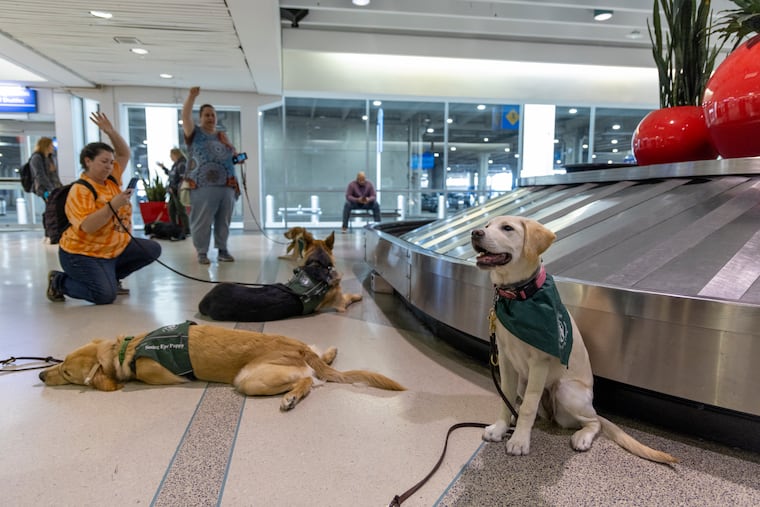
Guide dog trainees successfully navigated Philadelphia International Airport without requiring boarding passes.
At Philadelphia International Airport, the weekend buzz was not solely attributed to holiday travelers. A unique training initiative unfolded involving numerous Labrador retrievers, golden retrievers, and German Shepherds, led by volunteers passionate about helping individuals with visual impairments. These dogs, part of a training program managed by The Seeing Eye, a prominent nonprofit organization, were being socialized in a real-world environment tailored to enhance their future roles as guide dogs.
Kym Smythe, a puppy raiser from Bear, Delaware, accompanied her 12-week-old Labrador, Atlas, through the bustling concourse. Initially, Smythe reflected on the sensory overload that both humans and dogs experience within the airport setting. From the vibrant lights and busy foot traffic to the array of interesting scents, Smythe emphasized that puppies, like Atlas, need exposure to these stimuli to prepare them for their pivotal roles.
This training session at the airport aimed to familiarize the dogs with an environment they will inevitably encounter. According to Smythe, the process involves teaching dogs the importance of “intelligent disobedience.” This skill allows them to make discerning choices that could protect their visually impaired handlers from potential hazards. Such situations necessitate a balance where the dogs typically comply with commands but can override them in the interest of safety.
The training regimen begins as early as eight weeks of age, when these dogs are placed with volunteer raisers. This phase prioritizes socialization over specific task training; the dogs learn various experiences through everyday interactions. Volunteer puppy raisers play a critical role in this early development, shaping the dogs’ adaptability and confidence.
As the dogs mature to about 14 months, they undergo formal training at The Seeing Eye’s facility in Morristown, New Jersey. Not all dogs will pass the rigorous training and the organization has a contingency for those that don’t, providing them opportunities for adoption. For those that succeed, the matching process with visually impaired individuals considers various lifestyle factors to ensure compatibility.
This initiative significantly impacts both the dogs in training and the communities they will eventually serve. Anne Marie Barford, a dedicated volunteer who has raised 15 dogs, highlighted the personal fulfillment that comes from contributing to a cause that enhances the lives of visually impaired persons. The program not only fosters the dogs’ development but also enriches the lives of the volunteers involved.
The lively training session at the airport culminated in an imaginative scenario where the dogs and their handlers boarded a mock Frontier Airlines jet. While the aircraft was stationary, the experience aimed to simulate the boarding process they would eventually navigate alongside their future companions.
Amid the laughter and camaraderie, the overarching theme remained clear: the partnership between human and dog is a transformative one, promising significant improvements for people confronting visual challenges. For those considering a role in service dog training, The Seeing Eye encourages participation, underscoring that no prior experience is required and that the rewards of this endeavor extend far beyond the training itself.
For many, including Smythe, raising a service dog creates lasting connections and memorable experiences that shape their lives.