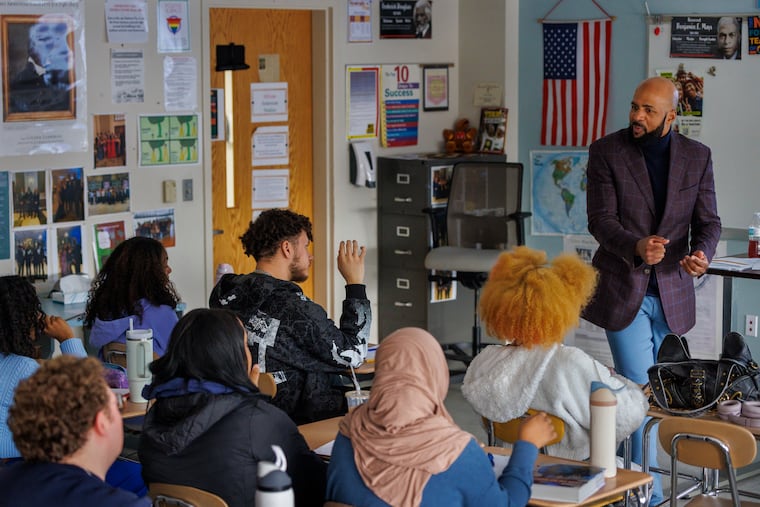
Haverford teacher without Black role models in school becomes finalist for National Teacher of the Year.
In an advancing exploration of cultural identity and history, Leon Smith, an educator at Haverford High School, has garnered recognition for his dynamic approach to teaching, particularly in his Advanced Placement African American Studies class. Recently, his students engaged in an analytical discussion centered around the poem “Heritage” by Countee Cullen, examining the poet’s intricate feelings regarding Africa, his ancestral homeland. Smith encouraged his students to consider how imagery in Cullen’s work, which portrayed Africa as primitive, may have appealed to white audiences, enabling Cullen to relate to a wider demographic before ultimately asserting the notion of civilization.
With 25 years of teaching experience in history, Smith’s methodology emphasizes understanding his audience. He believes that effective teaching begins with meeting students where they are, consequently enabling educators to convey meaningful messages. This innovative approach has contributed to his candidacy as one of five finalists for the National Teacher of the Year award. This accolade, awarded by the Council of Chief School Officers, offers a platform for Smith to advocate for the teaching profession nationwide.
At 46 years old, Smith has previously earned the title of Pennsylvania’s Teacher of the Year and is committed to addressing the challenges present in the educational workforce, particularly the decline in the number of new teachers. He argues that while many academically gifted students are encouraged to pursue careers in medicine or law, equally important is the promotion of educational careers, where leadership skills can significantly impact future generations.
In addition to teaching AP U.S. History and African American studies, Smith advises the African American Cultural Enrichment Club and coaches the freshmen boys’ basketball team. His principal, Pete Donaghy, commended Smith for his quiet yet profound influence on students, often mentoring them informally beyond the constraints of classroom hours. Donaghy highlighted Smith’s dedication to researching and promoting inclusivity within the school environment.
Notably, as a Black male teacher in a predominately white school district—where over three-quarters of students are white—Smith represents a vital perspective. The teaching staff has become more diverse since he began his tenure; a decade ago, he was the only Black male educator at the school, a figure that has since increased to three. Smith’s own educational journey was marked by a lack of Black male role models in teaching, which fuels his passion for creating opportunities for students from various backgrounds.
Growing up in a family of educators, Smith’s desire to make a difference solidified over time. He became inspired during his formative years in Upper Dublin, witnessing educators who went above and beyond their roles to positively shape their students’ lives.
In 2021, the College Board announced the establishment of an AP African American Studies course, prompting Smith to collaborate as a consultant. His classes have been well-received, enabling students to engage with critical historical perspectives on race and identity. Both his methodology and subject matter resonate deeply within the broader context of contemporary educational discourse, particularly amid increasing scrutiny from various political factions regarding the teaching of race-related themes.
Smith strives to connect the curriculum with personal narratives, exemplified through the sharing of his family’s history during discussions of significant events such as the Great Migration. Students have expressed profound appreciation for Smith’s pedagogical style, articulating that his classes have significantly influenced their understanding of complex social dynamics.
As Smith navigates his role as an educator, he actively engages in policy reform, advocating for the recruitment of diverse teachers, which currently stands at approximately 6.6% across Pennsylvania—significantly lower than the 38% of students representing diverse backgrounds. He emphasizes that to cultivate a pipeline of future educators, systemic barriers for aspiring teachers must be dismantled, along with a thorough analysis of racial disparities within educational settings.
Looking ahead, should Smith be named National Teacher of the Year in April, he intends to emphasize the importance of fostering positive learning environments that uplift both educators and students alike, underscoring the belief that joyful and confident teachers enhance student success and inspire the next generation of educators.
For more updates on education and teaching advocacy, stay connected with Media News Source.