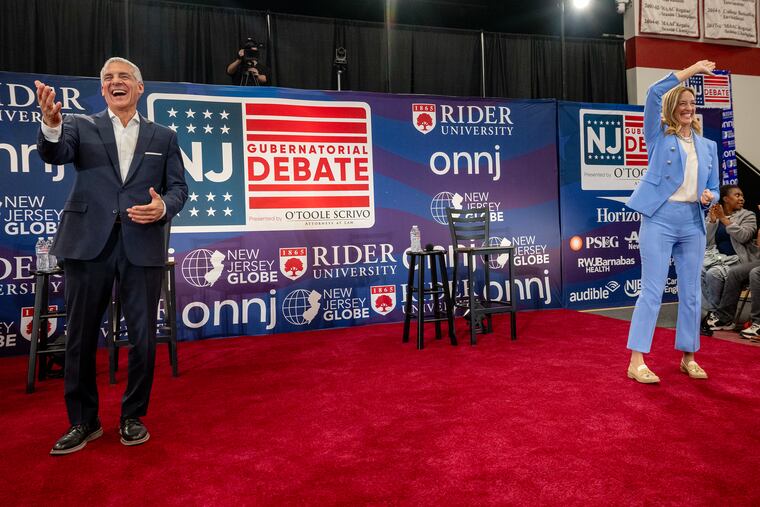
Highlights from the NJ governor’s race debate: lawsuits against Trump, remembrance of Charlie Kirk, and discussions on ending school segregation.
Approximately 1,500 attendees gathered at Rider University in Lawrenceville on Sunday evening for the inaugural debate between the leading candidates for the governor of New Jersey: U.S. Representative Mikie Sherrill, the Democratic nominee, and Jack Ciattarelli, the Republican nominee. The event focused on critical issues such as affordability in New Jersey, with candidates addressing inquiries from both moderators and the audience, which included participants as young as 12 and as elderly as 96.
During the debate, Ciattarelli aimed to discredit Sherrill by challenging her to provide specific details on her policy proposals, while Sherrill accused Ciattarelli of pandering to voters and suggesting he would “tell anybody what they want to hear.” This debate saw both candidates subtly shift their stances on various issues compared to their primary elections, particularly on matters like immigration policy and vaccination protocols.
On the topic of recent political violence, specifically following the assassination of conservative activist Charlie Kirk, Sherrill faced queries regarding her support for a Republican proposal to classify political violence as a hate crime. While Ciattarelli openly endorsed the proposal, Sherrill withheld her support, citing the need to scrutinize the wording to ensure it does not impinge on free speech rights.
Later in the debate, Sherrill confronted the complexities of New Jersey’s tax system. Ciattarelli proposed he would not raise sales taxes while pledging to reduce property and income taxes. However, Sherrill criticized his assertions as mathematically untenable, given the state’s financial obligations. She refrained from committing to not raising sales taxes, claiming a responsible fiscal approach would guide her decisions.
Immigration and public safety were also significant points of contention, with Sherrill indicating her reluctance to fully endorse the state’s Immigrant Trust Directive, which limits cooperation with Immigration and Customs Enforcement (ICE). In contrast, Ciattarelli promised to rescind these policies on his first day in office, asserting they hinder public safety.
The candidates also debated public health strategies and school segregation, topics that revealed contrasting philosophies regarding education reform and responses to public health crises. In particular, Sherrill criticized Ciattarelli for his previous anti-vaccine stance while he moderated his position during the debate to align more closely with mainstream medical recommendations.
In all, the debate served as a critical platform for both candidates to outline their visions for New Jersey while responding to citizen concerns. As the election approaches, the dynamics of these discussions will play a pivotal role in shaping voter perceptions and decisions.
Media News Source.