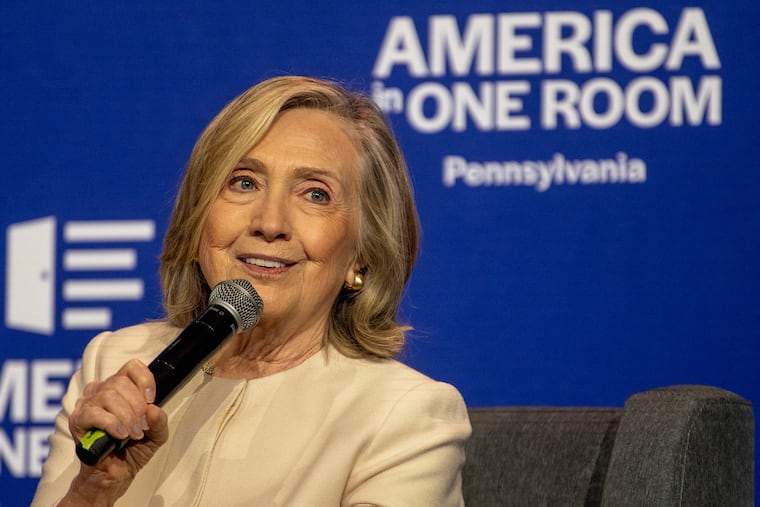
Hillary Clinton addresses diplomacy and defense issues at Pennsylvania event in Center City.
In a recent engagement with Pennsylvania voters, former Secretary of State Hillary Clinton showcased her extensive expertise in global affairs, offering insights on pressing issues that resonate with American citizens. The interaction occurred at a Center City hotel where Clinton served as the keynote speaker for the America in One Room/Pennsylvania event. This initiative, designed by Stanford University’s Deliberative Democracy Lab, aimed to bridge deep political divides by facilitating meaningful discussions among a diverse group of participants.
During the session, approximately 200 Pennsylvania residents took part in dialogues concerning complex topics such as international conflict, foreign aid, and the geopolitical implications of U.S.-China relations, particularly regarding Taiwan. Clinton emphasized the significance of these discussions in fostering an informed electorate capable of engaging with the multifaceted nature of contemporary governance.
Clinton addressed questions related to the potential ramifications of a Chinese invasion of Taiwan on trade dynamics. She asserted that the tariffs imposed by the Trump administration have already begun to inhibit imports from China, suggesting that this disruption could exacerbate economic challenges for the United States. She indicated that the underutilization of leading ports, such as Long Beach, is indicative of broader structural issues within the American economy, which may manifest more severely in the coming months as the effects of these tariffs ripple through the market.
A salient point Clinton raised was the necessity for a balanced approach to national security, arguing for both robust defense measures and strategic diplomatic efforts. She cited historical examples, including her husband’s administration’s successful negotiations in Northern Ireland and the Balkans, to illustrate the importance of engaging in both military action and diplomacy to achieve lasting peace.
Examining the implications of reduced foreign assistance, Clinton warned that a retreat from global engagement could result in a diminished American influence, allowing adversarial nations to fill potential power vacuums. She articulated her belief that the U.S. should not adopt a disengaged posture akin to that of the pre-World War II era, cautioning against allowing nations like China and Russia to exert unchecked influence in their respective regions.
Clinton’s perspective reflects a broader concern for international stability and America’s role as a global leader. She reiterated the importance of maintaining support for initiatives that promote healthcare, climate action, and democracy abroad, framing these efforts as beneficial not only to those countries but also to the American populace.
Ultimately, Clinton’s discourse echoed a call to action for thoughtful engagement with the international community, emphasizing that America must remain committed to its values of democracy and diplomacy in an increasingly complex world. Her participation in the event signals a continued commitment to public discourse on these pivotal issues as the country navigates its current political landscape.