Michener Art Museum Features Immersive Art Experience That Explores Light and Shadow Dynamics.
Anila Quayyum Agha, originally from Murree, Pakistan, has established herself as a transformative figure in contemporary art. From a young age, Agha demonstrated an innate talent for artistry, recalling early moments in elementary school when her watercolor paintings caught the attention of her teacher, who foresaw a future for her in art.
Currently on display at the Michener Art Museum in Doylestown, Pennsylvania, Agha’s midcareer retrospective titled “Interwoven” runs through January 11, 2024. This exhibition follows its debut at the Westmoreland Museum of American Art and showcases approximately 40 pieces that span her 20-year career in the United States.
Agha’s educational journey includes studying textile design at the National College of Arts in Lahore, encouraged by her mother who believed a fine arts degree would hinder her job prospects. She further honed her skills in fiber arts at the University of North Texas. During her studies in the early 2000s, Agha faced challenges in how the art world perceived fiber arts, often associated with craft and thus seen as lesser in status. Nevertheless, she leveraged this background to develop a unique artistic voice that transcends traditional boundaries.
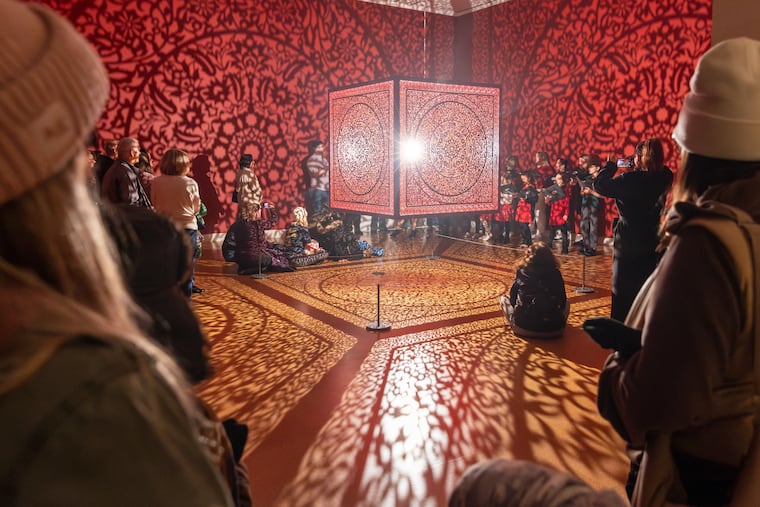
Her skillset shines through in her large-scale, laser-cut steel installations, which reflect intricate South Asian textile patterns reminiscent of traditional garments like the dupatta and wedding sari. One of the standout pieces, “All the Flowers Are For Me” (2016), is a striking 60-inch steel cube adorned with elaborate laser cuts. When illuminated, it casts captivating shadows that envelop viewers, prompting them to engage more deeply with the thematic exploration of identity and belonging ingrained in Agha’s work.
Laura Igoe, chief curator at the Michener Art Museum, notes that while Agha’s creations are visually stunning, they also carry subtle political messages about identity and the immigrant experience. The installations serve not only as artistic expressions but as reflections on societal notions of belonging, particularly in the context of Agha’s experiences as a South Asian immigrant.
Among the highlights of the exhibition is “A Flood of Tears (Gathering Storms)” (2010/2023), a monumental work composed of upholstery needles, bugle, and hematite beads. This piece is emblematic of Agha’s concern with climate change and its disproportionate impacts on countries with histories of colonization and resource exploitation. Through her art, she aims to amplify awareness and provoke discourse surrounding these pressing global issues.
Overall, “Interwoven” encapsulates Agha’s artistic journey, firmly rooted in craft while simultaneously challenging its conventions to elevate women’s contributions in the art world. Visitors to the Michener Art Museum will find themselves not only admiring exquisite artwork but also engaging with profound questions about identity and social justice, making this exhibition a pivotal experience in contemporary art.
For more information about “Anila Quayyum Agha: Interwoven,” visit the Michener Art Museum’s official website.