
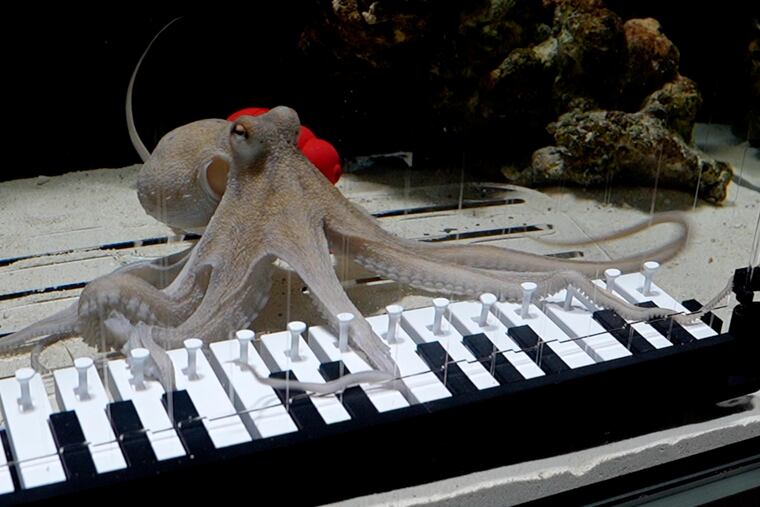
Musician successfully teaches octopus to play the piano.
Title: Octopus Takoyaki Takes Piano Lessons in Sweden: A Unique Journey of Inter-Species Learning
In a remarkable intersection of animal intelligence and human creativity, Mattias Krantz, a Swedish musician and YouTuber, has embarked on an unconventional project. After a five-hour plane journey, he welcomed an octopus named Takoyaki into his life, saving it from becoming a meal. With aspirations that might seem fantastical, Krantz hoped to teach Takoyaki to play the piano, envisioning performances of popular songs such as “Under the Sea” and the iconic theme from Jaws.
Krantz, who is known for modifying instruments in his YouTube videos, was drawn to the unique potential of octopuses. These intelligent creatures possess a complex nervous system that allows for independent movement of their eight arms, and Krantz hoped this trait would translate to musical ability. However, the task proved to be considerably challenging, demanding hundreds of hours of patience and dedication. His YouTube documentation of the endeavor has garnered over six million views.
Takoyaki, acquired from a Portuguese fishery, initially displayed typical octopus behavior, evading Krantz and taking time to adjust to its new environment. Krantz equipped a sizeable fish tank with an array of decorations and technology to ensure Takoyaki felt comfortable. The first task was to establish trust, achieved when Takoyaki began consuming food Krantz provided.
The teaching process began with a simple task: prompting Takoyaki to interact with a specially designed piano key. With each small success, Krantz expanded the piano setup, but he quickly learned that traditional methods would not suffice. Takoyaki’s disinterest in structured learning was evident, as the octopus often interacted with the tank environment instead of the piano.
Krantz’s determination led him to explore various teaching methods, including utilizing movement to attract Takoyaki’s attention. After several trials, he introduced an innovative tool – a “crab elevator” – to motivate Takoyaki to engage with the piano keys by rewarding it with a desired treat.
As weeks progressed, Takoyaki began to produce sounds on the piano, albeit inconsistently. The situation proved both rewarding and frustrating for Krantz, whose goal was never just to create music but to bond with the octopus. Marine scientists noted that, while octopuses display remarkable intelligence, they might not comprehend rhythm or tempo as humans do.
Krantz has kept Takoyaki as a pet despite the expectations of a brief lifespan, which is typical for octopuses. At approximately 14 months old now, Takoyaki continues to engage with the piano about every other day, showcasing a unique talent that astonishes Krantz each time.
This unconventional journey highlights not only the capabilities of octopuses but also the profound connection that can develop between species, blurring the lines between pet and partner. Ultimately, Krantz’s experience serves as a testament to the power of patience, ingenuity, and companionship in human-animal relationships.
Source: Media News Source


