
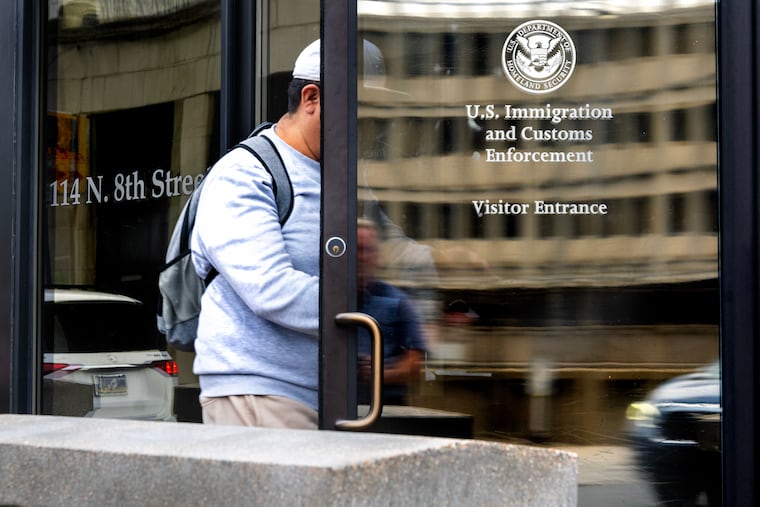
Philadelphia immigrants received unexpected Father’s Day notices requiring them to report to ICE.
Kathy Lou, a Pottstown resident, found herself anxiously pacing outside the U.S. Immigration and Customs Enforcement (ICE) office in Center City Philadelphia on a recent Sunday morning. She was waiting for news about her husband’s ability to leave the facility, a stark contrast to the Father’s Day barbecue she and her 12-year-old son had excitedly planned just a few days earlier. Lou expressed a palpable sense of unease, reflecting the tense atmosphere surrounding recent developments in immigration enforcement practices in the city.
On the preceding Friday, immigrant communities throughout Philadelphia received sudden and unsettling text notifications from ICE, summoning them to the North Eighth Street office for mandatory check-ins on Sunday between 8 a.m. and 4 p.m. The succinct nature of the messages, lacking any explanation for their urgency, raised eyebrows among lawyers and immigration advocates. They labeled the notifications highly unusual, especially given the short notice and included language warning recipients that noncompliance could lead to further legal ramifications. The number of individuals affected by this outreach remains uncertain, as does the method by which they were selected.
Emma Tuohy, chair of the Philadelphia chapter of the American Immigration Lawyers Association, reported that multiple clients reached out seeking legal assistance after receiving these notifications. She interpreted the timing—Father’s Day weekend—as possibly designed to complicate the ability of attorneys to offer support.
The situation unfolded following heightened protests against ICE activities in Philadelphia, where demonstrations had drawn tens of thousands of participants, showcasing widespread opposition to the agency’s raids and arrest practices.
As the Sunday morning check-ins began, a tense atmosphere replaced the prior demonstrations. A small crowd of anxious immigrants gathered outside, some possessing deportation orders, others seeking asylum, and some working toward green cards. Philadelphia Chief Defender Keisha Hudson confirmed that a number of current and former clients had received the ICE messages. Her office advised clients to arrive late in hopes of navigating the concerning situation with greater safety.
For Kathy Lou, the waiting game was agonizing. Her husband, an Ecuadorian immigrant and primary breadwinner of the family, was trying to secure permanent residency following a deportation 15 years earlier. Their son was left unaware of the day’s events, sheltered at home to prevent unnecessary worry. As the hours ticked by, the uncertainty deepened, with at least 20 individuals processing through the ICE office by noon, many facing unclear outcomes after lengthy waits.
Reports from those exiting the building told of mixed experiences. One woman, Maira, left devastated after her husband was taken into custody, while another individual, Caty, managed to have her status verified and was released. The stories revealed a stark and looming anxiety among those called into the ICE office, many of whom felt secure in their immigration status before the abrupt request to report.
By mid-afternoon, Kathy Lou remained hopeful but increasingly desperate as she awaited word on her husband. The intersection of family life and immigration enforcement raised broad questions about the stability and safety of immigrant families in Philadelphia during an era of changing policies and practices. At 4:20 p.m., an ICE van emerged from the building with detainees, and Lou’s emotions ran high upon spotting her husband among the passengers. The complexity and uncertainty of their situation underscored the ongoing struggle many immigrant families face in the United States.
This incident, reflecting broader national trends in immigration enforcement, highlights the urgent conversations surrounding the treatment of immigrants and the impact of ICE’s tactics on families and communities across the country.
Media News Source.


