
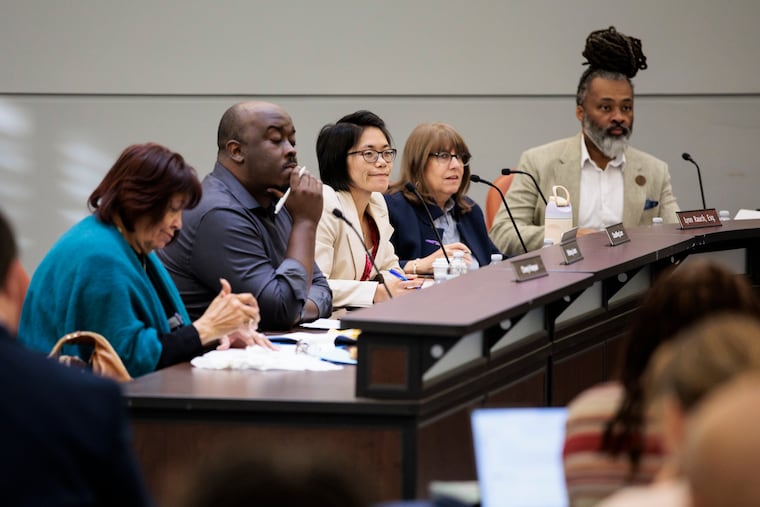
Philadelphia school board approves 0 million for school renovation projects.
The Philadelphia School Board has formally approved a substantial investment of up to 0 million for modernization initiatives across four city schools, aiming to enhance the learning environment for local students. This decision, reached during a meeting on Thursday night, positions the district to further its renovation agenda, prioritizing projects viewed as critical to improving educational facilities.
The board awarded a contract to the Philadelphia Authority for Industrial Development (PAID), which will oversee the selection of firms tasked with executing these modernization projects. The allocated funds will specifically target Bache-Martin Elementary School in Fairmount, which has a budget of million; million for Catharine Elementary in Southwest Philadelphia; million for Patterson Elementary, also in Southwest Philadelphia; and million for F.S. Edmonds Elementary in East Mount Airy.
District officials estimate that the renovations will result in an increase of 700 student seats, directly benefiting approximately 2,400 students. This initiative marks a significant step in the district’s billion facilities master plan, initially approved earlier this year. While a substantial portion of public discourse has centered around the contentious closure of 17 schools—met with significant opposition from various stakeholders, including City Council members and local communities—the district is now keen to spotlight its proactive renovation efforts.
Superintendent Tony B. Watlington Sr. emphasized the importance of advancing the ten-year facilities master plan from a theoretical framework to actionable projects. He highlighted a commitment to fostering safe, healthy, and modern educational settings for students, reflecting the district’s dedication to significant and meaningful investments in its infrastructure.
The PAID has previously facilitated similar undertakings, aiding in the construction of new schools across various neighborhoods in Philadelphia. In this particular resolution, PAID will spearhead the proposal process, select developers, and manage agreements with associated firms. Additionally, it will receive administrative fees not exceeding 1% of total payments made to contractors, capping out at million across all projects.
The modernization plans entail extensive improvements at each facility. Bache-Martin will see a new gym, cafeteria, and classrooms, as well as upgrades to HVAC systems, roofing, and windows. Catharine will receive similar expansions to accommodate an incoming student population due to the closure of Tilden Middle School. Patterson Elementary is set to add a gym or cafeteria, alongside necessary modernizations, while F.S. Edmonds will undergo renovations focused on accessibility and restroom facilities.
The board vote on the PAID resolution passed with a majority of six to one, though not without dissent. Board member Whitney Jones expressed apprehensions regarding the prioritization of these projects and the financial viability of the broader facilities plan, which seeks state and philanthropic funding for its complete realization.
In the backdrop of this vote, a rally outside the district headquarters garnered attention, with several community members, educators, and City Council representatives advocating against the proposed school closures. They voiced strong concerns for the impact of these closures on neighborhood stability and student wellbeing, framing the dialogue around the broader implications of educational infrastructure decisions in Philadelphia.
City Council members, including Isaiah Thomas and Jamie Gauthier, have been particularly vocal in seeking to preserve several schools. The ongoing debate underscores the tensions between necessary fiscal reforms and the imperative of community engagement in educational governance, suggesting that the future of Philadelphia’s educational landscape remains a complex, contentious issue.
As the district navigates its modernization plans alongside ongoing community advocacy, the actions taken now will influence not only the operational capacities of these schools but also the educational outcomes for generations of students in the city.


