Philly’s overlooked figure in abolitionism receives long-awaited recognition after years of being a historical footnote.
In the winter of 1773, Dianah Nevil, a woman of Indigenous, African, and European ancestry, arrived in Philadelphia with her children, making a significant claim that initiated a lengthy legal battle and influenced the formation of one of the first white abolitionist societies in the United States.
After being sold by Nathan Lowry of Flemington, New Jersey, to Benjamin Bannerman—an established slave trader—Nevil’s journey took a pivotal turn as she sought refuge in Philadelphia nearly 50 miles away. Bannerman had a problematic reputation, with reports of his abusive treatment of enslaved individuals surfacing as early as 1768. Amid the growing tensions preceding the American War for Independence, Nevil and her four children left Flemington, possibly acting on Bannerman’s orders or seeking asylum from enslavement.
Upon her arrival in Philadelphia, Nevil fervently declared her and her children’s freedom. At the time, the greater Philadelphia area housed approximately 945 enslaved individuals. In earlier years, the Philadelphia Yearly Meeting, an organization guiding Quaker congregations, had taken steps to disown members who engaged in the buying and selling of enslaved people, urging those holding individuals in bondage to emancipate them. Within this evolving moral landscape, Nevil’s claim was taken with gravity.
In an unfortunate turn, Mayor William Fisher placed Nevil in a workhouse located near the present-day Ben Franklin Museum, where conditions led to the deaths of two of her children. A dedicated group rallied to support her, forming the Society for the Relief of Free Negroes Unlawfully Held in Bondage, which fought for her rights in a legal struggle that would last for years. This collective later evolved into the Pennsylvania Abolition Society, the nation’s first society of its kind, aimed at abolishing slavery and providing assistance to those unlawfully enslaved.
By 1775, Nevil had found a temporary refuge on a property owned by a sympathetic Quaker tailor, Thomas Harrison. He eventually purchased Nevil for 225 pounds in 1779 and granted her and her children manumission, marking a significant legal victory in her fight for freedom.
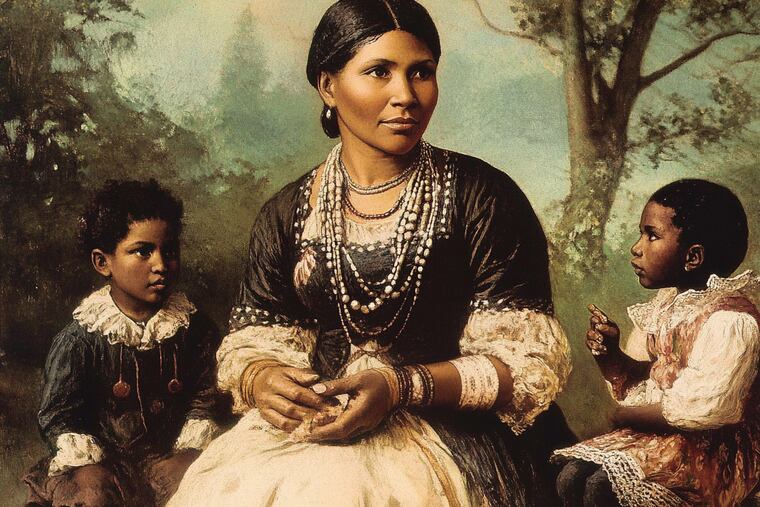
Recognition of Nevil’s historical importance has evolved over time. Though often mentioned only as an “anonymous Indian woman” in records, recent efforts have sought to amplify her story. Earlier this year, the Historical Society of Pennsylvania employed AI technology to create a new portrait of Nevil, portraying her alongside her children, emphasizing her heritage and dignity.
Research initiatives, such as the reparative genealogical project “339 Manumissions and Beyond,” aim to uncover the lives of freed individuals like Nevil, focusing on their struggles and achievements. These efforts have revealed that, despite the challenges, Nevil’s children became heads of households in subsequent decades.
In her relentless pursuit of freedom, Nevil not only changed the course of her own family lineage but also contributed to the broader abolitionist movement in America. Her legacy stands as a testament to the complex histories of race, identity, and the quest for autonomy in early American society. Media News Source.