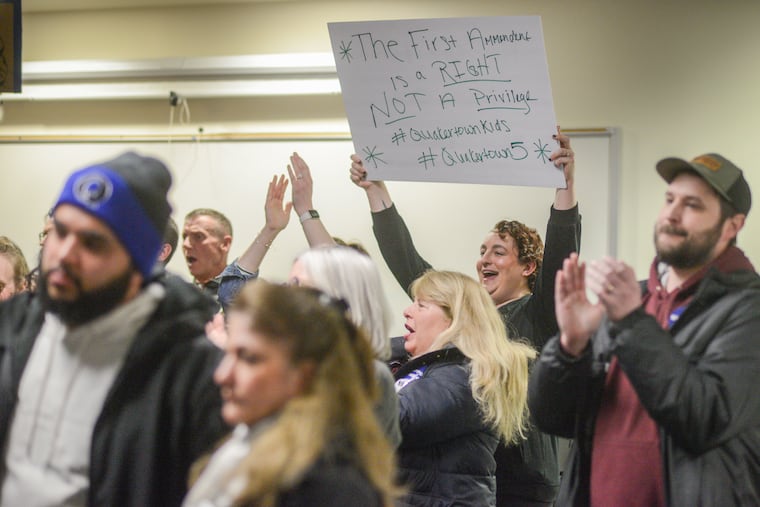
Quakertown school leaders face allegations from community members regarding mishandling of student ICE protest.
Community members expressed their frustration with the Quakertown school board during a recent meeting, accusing officials of failing to ensure the safety of students during a walkout against immigration enforcement that occurred last week. This event, which ended in confrontations with law enforcement, resulted in the arrest of five teenagers.
The school district had previously attempted to cancel the planned walkout, citing what officials described as a credible threat. However, many community members criticized the board for not allowing students to protest on school grounds, suggesting it would have provided a safer alternative to leaving the campus. Jessica Buhman, a parent with children in the district, voiced her concerns, pointing out that the risks associated with leaving the school were apparent and regrettably realized.
Others argued that the district should not have allowed the walkout to occur at all, with some stating that such protests are not conducted in a professional setting. A total of approximately 35 students left the high school on the day of the protest. According to school officials, they had no authority to prevent the students from exiting.
The protest escalated into a confrontation with local law enforcement, during which video footage captured a plainclothes police officer allegedly placing a girl in a chokehold. A police affidavit reported that students had blocked traffic and assaulted police Chief Scott McElree, who was also identified as the borough manager. The details of the chokehold incident were not documented in the report.
The five arrested students were charged with aggravated assault, a felony offense, and while four were released by Thursday, the fifth was expected to be freed later that evening. Defense attorneys for two of the students contested the police accounts, asserting that their clients did not physically assault McElree and that he failed to identify himself before engaging with the youths.
At the board meeting, attendees voiced their displeasure with the school district’s handling of the situation, questioning how administrators could have failed to anticipate student action. Many audience members highlighted concerns over the district’s lack of transparency regarding the alleged threat that led to attempts to cancel the protest. Furthermore, critics expressed disappointment that the district did not extend any statements of support for students who had been arrested or injured during the clash.
The atmosphere during the meeting grew tense as residents shared their perspectives, with some suggesting the need for the district to reevaluate its handling of student protests. Outside the building, supporters carried signs advocating for the students, emphasizing the importance of free speech and participation in civic discourse.
This incident has sparked broader discussions on issues such as tolerance and racism within the Quakertown community. In response to the emotional testimonies from community members and students, board member Chris Spear suggested that the district might benefit from bringing in a consultant to address underlying issues of systemic discrimination and communication failures. The incident has not only raised concerns about student advocacy and safety but has also underscored the complexities of managing youth activism in school settings.
The Quakertown situation illustrates the challenges faced by school administrations when balancing the rights of students to express their opinions against concerns about safety and order, a dilemma that continues to resonate in educational institutions nationwide.