Regime Claims No Errors in Governance Approach
Manuel Contreras, the notorious leader of Chile’s secret police during the military dictatorship from 1973 to 1989, is often cited for providing a chilling rationale for the regime’s violent tactics. His perspective on state violence included a justification for targeting individuals who appeared innocent, such as students and local activists, asserting that their dissimulation made them viable targets in the eyes of the state. This troubling sentiment echoes in contemporary discussions surrounding state-sanctioned violence, especially in relation to immigration enforcement in the United States.
In recent developments, a significant portion of Venezuelan deportees sent to El Salvador has been described as lacking any criminal backgrounds. Robert Cerna, a field director for U.S. Immigration and Customs Enforcement (ICE), stated that around 75% of these deportees had no documented criminal history. This reflects a troubling pattern within the current administration’s approach to immigration and law enforcement, which has evoked parallels to the authoritarian tactics employed in past regimes.
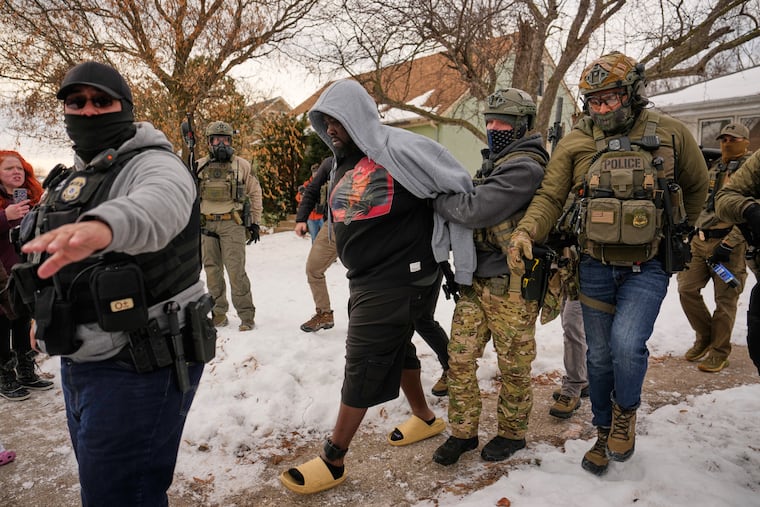
As an academic specializing in authoritarian politics, the behavior of the Trump administration has raised serious concerns regarding the principles of state terror and the mechanisms of repression. The recent operations conducted by ICE have raised alarms, especially in light of claims made by officials suggesting that victims of violence or arrest deserved their fate, further complicating the narratives surrounding victimization.
In January 2026, Secretary of Homeland Security Kristi Noem described the aftermath of a shooting involving an ICE agent as an act of “domestic terrorism,” directing scrutiny onto the victim, who was shot while observing a raid. This rhetoric reflects a broader trend within the current administration, deftly shifting blame back onto victims to rationalize state violence.
The recent fatal incidents involving federal agents in Portland and elsewhere illustrate a disturbing consistency in how violence is framed as necessary, often targeting individuals designated as part of organized crime networks. Assertions that victims instigated their own deaths reflect historical patterns of victim-blaming that characterized the rhetoric of repressive regimes, such as that of Augusto Pinochet in Chile.
These narratives shift the focus away from accountability, inadvertently endorsing a culture where violent state actions are accepted if viewed as justified. Such conditioning was evident in Argentina during its military dictatorship, where the phrase “Por algo será” implied that victims must have warranted their fate.
The implications of dehumanizing rhetoric in state violence and repression cannot be overlooked. The tragic death of Renee Good, a mother who was killed during an immigration enforcement action, serves as a poignant reminder: the identity of victims should not determine the moral implications of their deaths. The persistence of state violence mandates ongoing scrutiny and accountability. It is imperative for citizens to reject narratives that obscure the violation of fundamental human rights and to demand transparency and justice in the face of such crimes.
Media News Source