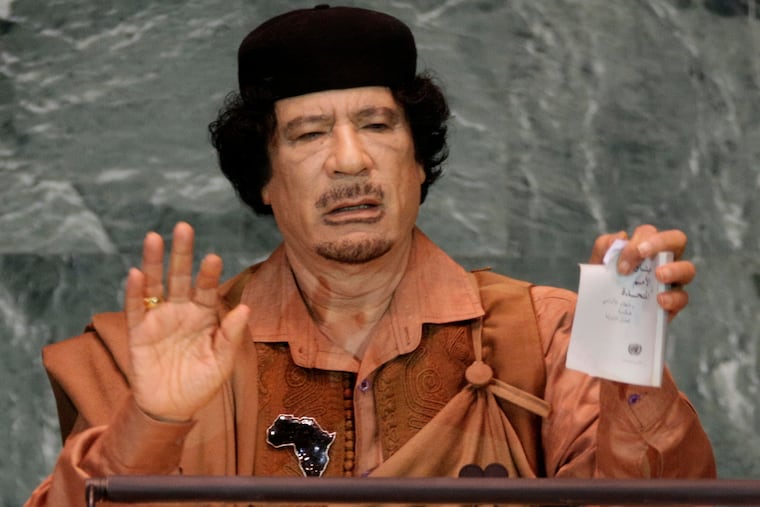
Seif al-Islam Gadhafi, son of Libya’s former dictator, has been reported killed in North Africa, according to officials.
CAIRO — Seif al-Islam Gadhafi, the son of the late Libyan dictator Moammar Gadhafi and once viewed as his heir apparent, was reportedly killed in Libya, according to multiple security officials. The incident occurred in the town of Zintan, located approximately 85 miles southwest of the capital, Tripoli. The announcement of his death was corroborated by two Libyan security officials who requested anonymity due to the sensitive nature of the situation.
Confirmations of Gadhafi’s death surfaced through social media, where Khaled al-Zaidi, his lawyer, and Abdullah Othman Abdurrahim, a representative for Gadhafi in UN-brokered political discussions, shared the news. Abdurrahim, who has been actively engaged in the political landscape of Libya, stated the armed assailants killed Gadhafi in his residence. Various accounts indicate that prosecutors are currently investigating the circumstances surrounding the incident.
Further details have emerged indicating that a group of four masked men forcefully entered Gadhafi’s house, leading to what his political team characterized as a “cowardly and treacherous assassination.” The statement from his team also reported that the assailants had disabled the CCTV cameras at the location in an apparent effort to obscure the events of the attack.
Born in June 1972 in Tripoli, Seif al-Islam was the second son of Moammar Gadhafi. He pursued higher education, earning a Ph.D. from the London School of Economics, and was often seen as a potential reformer within his father’s increasingly unpopular regime. Following the collapse of his father’s government during a NATO-supported uprising in 2011, which ultimately led to Moammar Gadhafi’s death, Libya has been engulfed in a protracted civil conflict marked by the fragmentation of power among various militias and political factions.
Seif al-Islam was captured in late 2011 while attempting to escape to Niger but was released in 2017 after receiving amnesty from a rival government. However, his past remained controversial, marked by a 2015 conviction in absentia for inciting violence during the protests that led to his father’s downfall, along with an outstanding warrant from the International Criminal Court for crimes against humanity.
In November 2021, he announced his candidacy for the Libyan presidential election, drawing significant backlash from anti-Gadhafi factions across the country. Although the High National Elections Committee disqualified him from running, the election itself did not occur due to ongoing disputes among competing factions that continued to destabilize Libya.
The death of Seif al-Islam Gadhafi marks a notable moment in Libya’s turbulent history, raising questions about the future political landscape of a nation still grappling with its significant past and uncertain future. The investigation into his assassination may shed light on the complexities and dangers lurking within Libya’s ongoing struggle for stability and governance.
Media News Source.