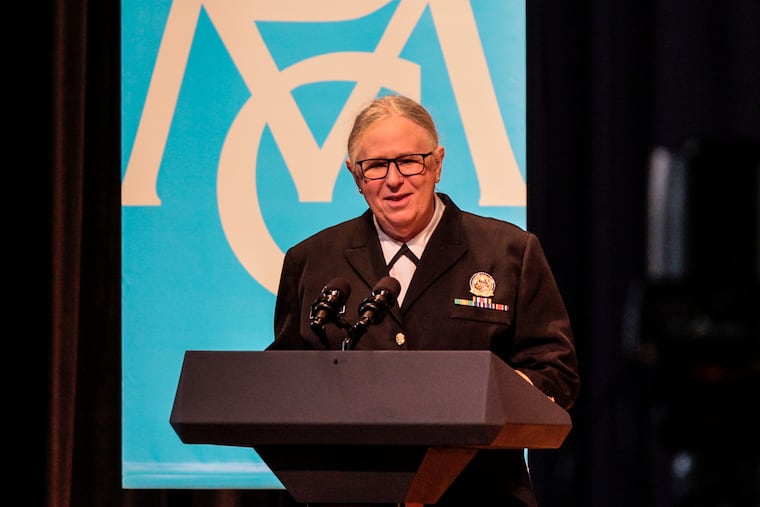
Trump administration alters name on portrait of former Health Secretary Rachel Levine, who remains silent on the change.
During the recent federal government shutdown, the U.S. Department of Health and Human Services (HHS) made a controversial decision to modify the name displayed beneath the official portrait of Admiral Rachel Levine, a prominent transgender figure in American government. The alteration reverted to her birth name, also known as her “dead name,” which has ignited significant backlash from LGBTQ advocates and allies.
Admiral Levine previously held the position of assistant secretary for health under President Joe Biden and is recognized as the first openly transgender official confirmed by the U.S. Senate. Her career includes roles as Pennsylvania’s physician general and health secretary, where she was instrumental in managing the state’s response to various public health crises, including the COVID-19 pandemic and the opioid epidemic, as well as establishing Pennsylvania’s medical marijuana program.
The term “deadnaming” refers to the practice of using a transgender person’s birth name instead of the name they have chosen for themselves, a move that many consider to be harmful and stigmatizing. Deja Alvarez, an LGBTQ community leader, has condemned the practice as a severe affront to dignity and respect, calling it “a horrible thing to do to vilify a group of people.”
While Levine herself has not publicly commented on the HHS’s actions, Adrian Shanker, her former deputy assistant secretary for health policy, characterized the name change as “petty” and noted that it overshadowed more significant priorities during a government shutdown. Shanker emphasized that Levine has received an outpouring of support in the wake of this decision, which he described as inexplicable given the context of ongoing federal operations.
In response to queries regarding the name alteration, HHS officials conveyed that their commitment lies in aligning internal and external communications with “gold standard science” while also hinting at a philosophical pivot towards embracing biological realities in public health policy. This stance has raised questions, particularly given the previous advances in civil rights that have been gradually undone by the current administration.
Throughout her tenure, Admiral Levine has made significant strides concerning public health and LGBTQ representation at high government levels. Notably, she has been involved with issues ranging from HIV education to climate change and long-COVID research, reflecting her broad impact on national health policy. Her extensive experience in pediatrics, including a two-decade affiliation with Penn State Health Milton S. Hershey Medical Center, precedes her ascent into public service.
In light of HHS’s announcement, critics, including Pennsylvania State Representative Dan Frankel, have decried the move as an act of “political malice,” further highlighting the challenges that LGBTQ individuals face within governmental structures. The Trump administration laid the groundwork for numerous rollbacks on civil rights, particularly for transgender and LGBTQ Americans, a concern that remains relevant as current policies continue to evolve.
This incident represents not just a moment for Admiral Rachel Levine but also a broader commentary on the ongoing struggles for representation and dignity within public life for marginalized communities across the country. As the conversation around gender identity and civil rights progresses, the implications of such symbolic gestures may resonate beyond merely a name, reflecting deeper societal values and priorities.
Media News Source.