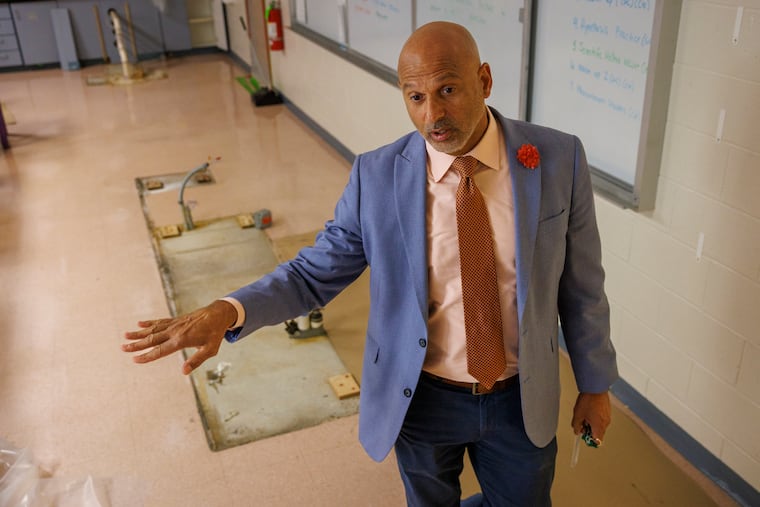
Winslow Middle School students will continue on a hybrid schedule for several months due to water damage in the building.
In September, shortly after assuming the role of interim Superintendent in Winslow Township, Mark Pease faced a formidable challenge when a burst pipe at Winslow Middle School resulted in significant flooding throughout the premises. The incident, which submerged a substantial portion of the building under several inches of water, marked Pease’s first major test as he stepped in for Superintendent H. Major Poteat, who is currently on medical leave.
In response to the flooding, Pease made the decision to temporarily close the middle school for three days. This institution, which serves approximately 740 seventh and eighth graders, is now operating under a hybrid learning schedule. Students attend in-person classes for two days a week while engaging in virtual learning for the remaining three days. This revised schedule is necessary due to the school’s inability to accommodate its full enrollment simultaneously, as the flooding damaged around twenty-eight classrooms, two gyms, the library, the main office, and the entrance.
Originally anticipated to last one month, the repairs initiated by All-Risk Property Damage Experts Inc., a company specializing in school restorations, are now forecasted to extend until January or February. Following the removal of standing water, contractors are diligently working to dry out the facility and assess it for mold and air quality issues, necessitating the removal of drywall and flooring.
Pease estimates that the total repair costs will exceed million, with the majority being covered by insurance after a ,000 deductible. A precise determination of the cause of the water main break is still pending, although custodians were present on-site when the leak began.
As recovery efforts continue, contractors have been making considerable progress, with some areas of the school unaffected by the flooding being utilized for classes. The cafeteria remains operational, providing meals on in-person learning days, while to-go options are available during virtual days. Although some parents expressed a desire to relocate students to alternative facilities, Pease noted that space constraints within the district, which serves approximately 5,000 students across nine schools, precluded such a move.
Despite the unique challenges of the hybrid learning model, which has brought forth social and emotional difficulties for students, including feelings of isolation, the district has sought to implement effective solutions swiftly. Students are following an A-B schedule, allowing half of the student body to attend in-person classes on alternating days.
Ongoing parental concerns about educational setbacks echo sentiments from the previous pandemic, when students experienced significant learning losses. Pease and his team remain committed to monitoring academic performance closely, ensuring tutoring and remediation opportunities are accessible if necessary. As recovery progresses, the district aims to return to a normal learning environment as soon as feasible.
The approval of the hybrid plan by the New Jersey Department of Education came with the condition that the missed days would be made up, while other schools in the district continue their regular schedules. As Pease navigates these turbulent waters, he emphasizes that the goal remains to reintegrate students back to their traditional learning environment.
Pease, who brings 32 years of educational experience, views this crisis as one of the most significant challenges of his career. He remains dedicated to ensuring that students are back in school as soon as conditions allow. Media News Source.