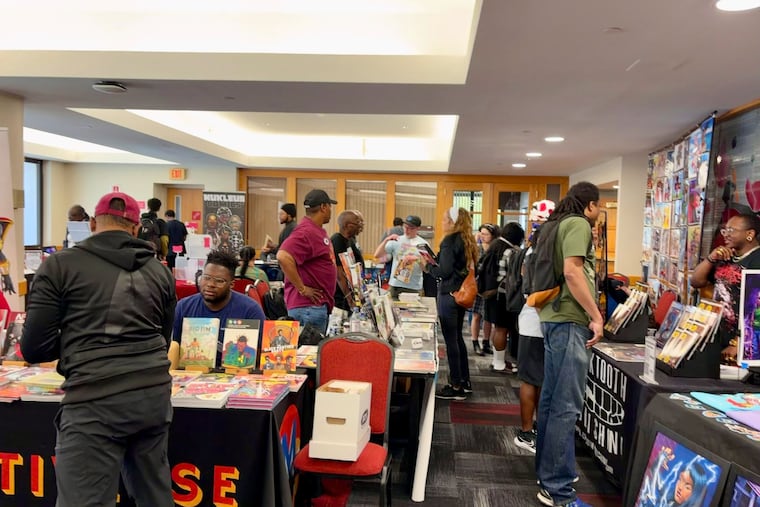
Philadelphia Black comic book convention highlights the significance of creator culture in the era of AI.
As members of the last graduating class of the University of the Arts, Chris Williams, 26, and Miles Hubbard, 24, confronted an immediate and uncertain future. The closure of their institution, coupled with the challenges of establishing careers as illustrators in a landscape increasingly dominated by artificial intelligence, loomed large as they stepped into adulthood.
Fast forward two years, and the landscape has shifted significantly. While showcasing their illustrations, stickers, and posters at the Temple University Student Faculty Center, Hubbard experienced a poignant full-circle moment. He was participating in the East Coast Black Age of Comics Convention—an event that had first welcomed him as a budding artist during his middle school years.
Founded in 2002, the East Coast Black Age of Comics Convention aims to bridge gaps in representation and literacy within Black communities while fostering connections among Black comic book creators and their audiences. The convention not only promotes comic book culture but also hosts workshops and cosplay events year-round to encourage creativity and collaboration among participants.
Celebrating its 25th anniversary, this year’s convention featured a panel discussion focused on the implications of artificial intelligence within the artistic realm. While many attendees are creators themselves, few reported utilizing AI as part of their artistic processes. Yumy Odom, the convention’s founder, expressed concerns about how an overreliance on technology could detract from the human element in art. He noted that while AI can draw from vast data sets, it lacks the cultural context that informs personal artistic expression.
Board game creator Keith Atkins, aged 50, has discovered that AI can serve as an unexpected ally in his work. After spending 14 years meticulously designing every aspect of his board games, Atkins commissioned an illustration for a game box, only to learn that it had been generated by AI. Initially conflicted about this development, he ultimately decided that channeling his creative energy into game design was more beneficial than focusing on packaging.
Atkins has found value in employing AI to enhance his marketing efforts, though he remains firm in his belief that the essence of each game springs from human creativity and in-depth thought. He emphasized that while AI can assist in generating artwork, it should not overshadow the human experiences and narratives that define the core essence of a game.
For Williams, the boundary between human creativity and artificial intelligence is especially significant. As an illustrator of a children’s book that addresses food scarcity through the eyes of a young boy in the Southern United States, he feels AI cannot replicate the nuanced human experiences that allow stories to resonate on a deeper level. He articulated that true representation and emotional depth in art require a human touch that AI simply cannot offer.
As discussions surrounding the role of artificial intelligence in creative fields continue to evolve, the experiences of Williams and Hubbard reflect broader dialogues about authenticity, representation, and the essential human essence in art.