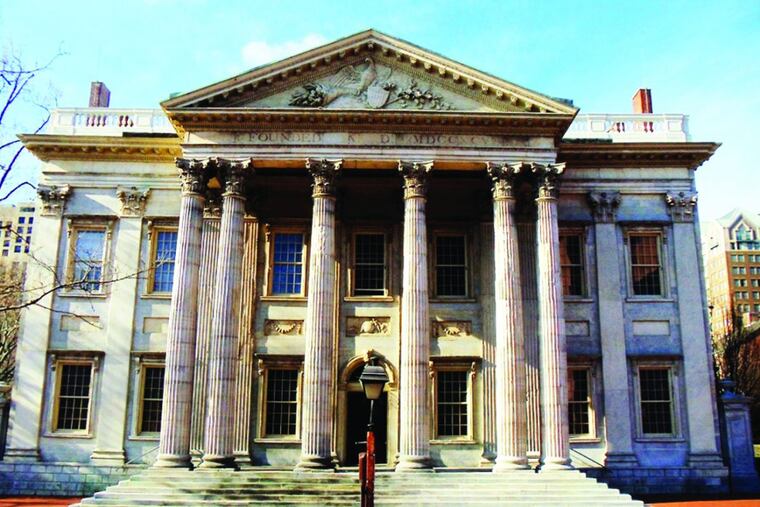
Hamilton advocated for Philadelphia’s economic growth and pushed to establish the Federal Bank’s headquarters in the city.
In the wake of the Revolutionary War, the United States faced significant economic challenges during the 1790s. With widespread financial instability and a government struggling to meet its fiscal obligations, the nation required a robust financial infrastructure to ensure its survival. Alexander Hamilton, the first Treasurer of the United States, proposed the establishment of a national bank to serve as the government’s primary fiscal agent. This institution would not only issue paper currency but also manage the country’s finances, including bill payments and tax collection, thus enabling the fledgling nation to support itself.
Hamilton’s ideas were influenced by the British banking system, which he studied extensively. He recognized the necessity for a similar structure in America, believing it would help build the country’s fiscal authority. On February 8, 1791, Congress complied with Hamilton’s vision by enacting legislation that founded the first federally backed bank in the United States, situated in Philadelphia’s Carpenter’s Hall.
The First Bank of the United States was a significant milestone in American history, and its establishment will be commemorated on July 4 at its later location on South 3rd Street. The celebration is part of the Historic District’s “52 Weeks of Firsts” initiative, which seeks to honor the various pioneering elements of Philadelphia’s rich history.
As part of the upcoming Semiquincentennial celebrations, the National Park Service will reopen the First Bank to the public on July 1, following an extensive rehabilitation costing approximately million. This beautifully restored Greek Revival building will display exhibits focusing on the history of American banking.
Before the First Bank, the Bank of North America was created in 1781 by the Continental Congress to provide loans for the Revolutionary War. However, some key figures, including Thomas Jefferson, argued against the need for a federal bank, viewing it as an overreach of government power.
As the capital relocated to Washington, D.C., in 1800, Hamilton advocated for the First Bank to remain in Philadelphia until the end of its charter. Despite his efforts, the charter expired in 1811 and was not renewed by President James Madison, leading to the building’s acquisition by Stephen Girard, who opened a private bank there.
The economic strain of the War of 1812 led to the establishment of the Second Bank of the United States in 1816. However, its charter also faced expiration in 1832 under President Andrew Jackson, who opposed the federal banking concept. As a result, the country operated without a federal banking system for 77 years.
The banking landscape shifted dramatically in 1907 when J.P. Morgan and a group of bankers intervened to prevent a financial collapse, prompting discussions for a new national bank. This culminated in the Federal Reserve Act, signed into law by President Woodrow Wilson in 1913, which established the modern federal banking system comprising 12 branches, including one in Philadelphia.
Today, the Federal Reserve functions as the fiscal agent for the U.S. Treasury, overseeing the issuance of currency, tax collection, and bill payments, though it no longer offers private loans. Originally established with a 20-year charter, the Federal Reserve was granted perpetual succession with the passage of the McFadden Act in 1927, marking a significant evolution in America’s banking system. The long journey towards an effective federal banking structure reflects the complexities of America’s fiscal policy and the challenges of governance throughout its history.
The First National Bank’s legacy will be honored on July 4, from 11 a.m. to 1 p.m., inviting all to reflect on America’s financial heritage.
Media News Source