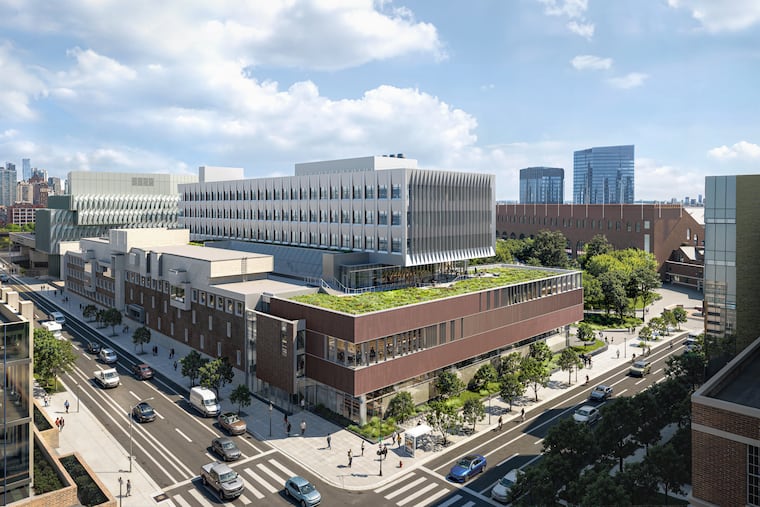
Penn announces a 0 million renovation of David Rittenhouse Lab, marking it as one of Philadelphia’s largest construction projects.
In an ambitious effort to modernize its facilities, the University of Pennsylvania has announced a significant redevelopment project for the David Rittenhouse Laboratory, a structure that has served its math and physics departments since 1954. Valued at an estimated 0 million, the project will involve the demolition of approximately two-thirds of the current lab building, making way for the construction of the new Penn Discovery Commons.
The new facility will span seven stories and encompass 325,000 square feet, reflecting a major upgrade over the existing mid-century structure, which has long been criticized for its outdated features, including a lack of central air-conditioning. University officials have emphasized that the current lab’s limitations have made it increasingly unsuitable for modern scientific work. Dean of the School of Arts & Sciences, Mark Trodden, noted that the facility fails to meet contemporary needs for temperature control and workspace functionality.
The decision to revamp the Rittenhouse Laboratory comes after a decade of considerations regarding its replacement. The project will be designed by CO Architects, a firm recognized for its innovative designs in educational and medical facilities, in collaboration with local firm Ewing Cole. This initiative is notable not only for its scale—it stands as the largest single construction project in the university’s history—but also against a backdrop of funding challenges faced by educational institutions.
While the university has made strides in various real estate projects, including a new wrestling facility and an expansion of the Annenberg Center for Performing Arts, the Penn Discovery Commons represents the largest investment at this time. Its budget surpasses that of the nearby 0 million TerraPower Isotopes factory, although it is still dwarfed by the .5 billion new patient tower being constructed by the Children’s Hospital of Philadelphia, expected to be completed in 2028.
Constructed in several phases beginning in 1954, the Rittenhouse building contains an older section that will be preserved as part of the new facility. This decision aligns with sustainability goals, indicating that modern construction will leverage some existing structures to minimize environmental impact. The renovated facility is intended to promote collaboration, featuring additional research and classroom spaces alongside social areas designed to foster spontaneous academic interaction.
Preparations for the redevelopment will commence next year, with plans for relocation of tenants and subsequent demolition set to take place by spring 2028. Completion of the new facility is targeted for September 2031. However, some faculty members have expressed concerns that the temporary relocations could disrupt vital research activities, prompting the university to assure that accommodating researchers’ needs will remain a priority during the transition.
As the University of Pennsylvania continues to evolve its campus and facilities, the Penn Discovery Commons stands as a testament to its commitment to advancing academic excellence through improved infrastructure and resources.