
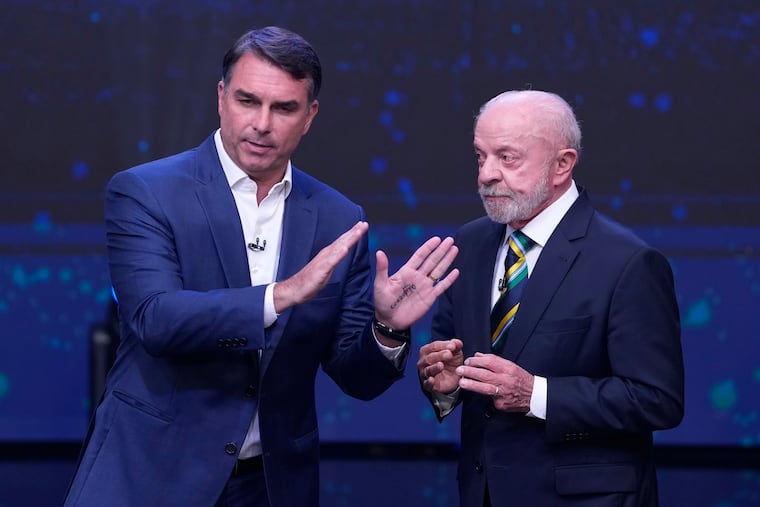
Brazilians vote today in the presidential election, choosing between candidates Lula and Flávio Bolsonaro.
In an election that could shape Brazil’s future, voters are faced with the decision to either re-elect incumbent president Luiz Inácio Lula da Silva or pivot toward the far-right by supporting Senator Flávio Bolsonaro, son of former President Jair Bolsonaro. Lula, at age 80, is vying for a fourth presidential term after previously serving as president from 2003 to 2010 and beginning a third term in 2023. Flávio Bolsonaro, 45, is attempting to restore his family’s political legacy amidst his father’s ongoing corruption issues.
Lula and Flávio Bolsonaro faced off in a recent first-round election where the younger Bolsonaro garnered 47% of the votes compared to Lula’s 45%. No candidate achieved a majority, setting the stage for a runoff election. With more than 2.2 million votes separating the two candidates, recent polls indicate that the race remains closely contested as voters prepare to return to the polls.
Lula’s political journey is marked by his humble beginnings as a union worker, a background that has garnered him a dedicated following. Throughout his earlier terms, Brazil experienced significant economic growth, credited partly to a commodities boom and social programs that reduced poverty. However, his popularity has waned in recent times, dropping to as low as 24%, driven by rising crime rates and a higher cost of living.
In response to these challenges, Lula’s administration has initiated various policy measures, such as increasing payments to the Bolsa Familia welfare program by 15% and cutting fuel taxes. Additionally, the government has changed labor laws to reduce the maximum workweek from 44 hours to 40, providing workers with two non-paycheck rest days.
On the other hand, candidate Flávio Bolsonaro is known for his hardline stances on crime, proposing measures including the construction of large prisons modeled after those in El Salvador and labeling criminal organizations as terrorist groups. His father’s administration faced severe criticism for fostering environmental degradation, particularly in the Amazon rainforest, an issue that has persisted in Flávio’s campaign as he minimizes the importance of human-induced climate change.
Furthermore, Flávio Bolsonaro’s recent admission of receiving significant financial support from a controversial banker has prompted investigations into corruption, adding another dimension to his campaign’s challenges.
As the election approaches, Lula has made it clear he intends to defend Brazil’s sovereignty, particularly in the face of U.S. influence. The political landscape reveals a deep divide, with implications reaching beyond borders, as both candidates appeal to distinct voter bases.
Voting in Brazil is mandatory, and approximately 160 million citizens are eligible to participate. Historically, turnout can be affected by disengagement; in the most recent election, nearly 21% of the electorate abstained. As the country’s political climate continues to shift, the results of this pivotal runoff will play a critical role in defining Brazil’s future trajectory.


