
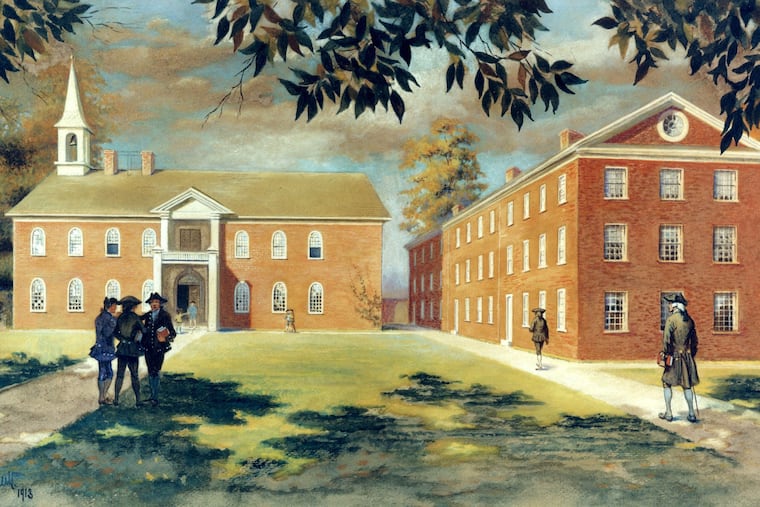
In 1740, Anglican priest George Whitefield convened fellow clergymen at a prominent meetinghouse located at Fourth and Arch Streets in Philadelphia. Whitefield, revered as a foundational figure in the modern evangelical movement, envisioned Philadelphia as the headquarters for a new Christian denomination. His aspiration was for preachers from diverse backgrounds to converge in this city to address their congregations. However, by the late 1740s, financial difficulties plagued both Whitefield and his movement, leading to the abandonment of the once-promising site.
During this time, Benjamin Franklin emerged with a radical educational vision. While many of the nation’s first colleges were established to prepare individuals for religious vocations, Franklin proposed an institution that would embrace a broader curriculum focusing on humanities, arts, sciences, and the study of antiquities. His vision culminated in the establishment of the College, Academy, and Charity School of Philadelphia, which opened its doors to students in 1751 after Franklin garnered support from influential Philadelphians and secured the former clergymen’s building.
The establishment of this institution marked the inception of Pennsylvania’s first school of higher learning, which would eventually evolve into the University of Pennsylvania—the first university in the United States. The milestone will be commemorated this Saturday as part of the Philadelphia Historic District’s firstival, a series of weekly celebrations honoring American institutions with roots in Philadelphia.
This week’s firstival is scheduled from 11 a.m. to 1 p.m. at Penn’s Houston Hall, amplifying the significance of the university in historical and educational contexts. In 1755, following a new charter, the institution was named the College of Philadelphia with William Smith serving as its inaugural provost. The first class, consisting of just seven boys, graduated in 1757, laying the groundwork for what would become a significant center of learning.
The transition from college to university occurred in 1765 with the introduction of the country’s first medical college, fundamentally altering the educational landscape. The 18th century also witnessed upheaval due to the Revolutionary War, during which Pennsylvania’s legislature realigned the institution, renaming it the University of the State of Pennsylvania. This rebranding marked it as the first school to feature the term “university” in its title.
Post-war developments redirected the university’s trajectory. By 1791, Pennsylvania’s new state constitution legally merged the two educational entities, formally establishing the University of Pennsylvania as a private institution. The university’s relocation to 9th Street and Market further anchored its role at the heart of Philadelphia’s social and political life.
As the years progressed, by 1872, the university moved to its current West Philadelphia campus, signaling a new era of academic prominence. The introduction of graduate programs in 1882 echoed the changing educational landscape, propelled further by the growth spurred in the late 19th and early 20th centuries.
In 1954, the University of Pennsylvania became one of the founding members of the Ivy League athletic conference, solidifying its prestige. Today, the university supports over 30,000 students and employs more than 6,049 faculty members across its four undergraduate schools and twelve graduate and professional schools. The firstival this week serves not only as a remembrance of the university’s roots but also as a celebration of higher education’s evolution in America.
The Firstival will take place on Saturday, March 28, from 11 a.m. to 1 p.m. at Houston Hall, located at 3417 Spruce Street, inviting the community to engage in the historical context surrounding this esteemed institution.
This article is part of the Philadelphia Historic District’s “52 Weeks of Firsts” initiative, highlighting significant moments from the region’s rich history.