
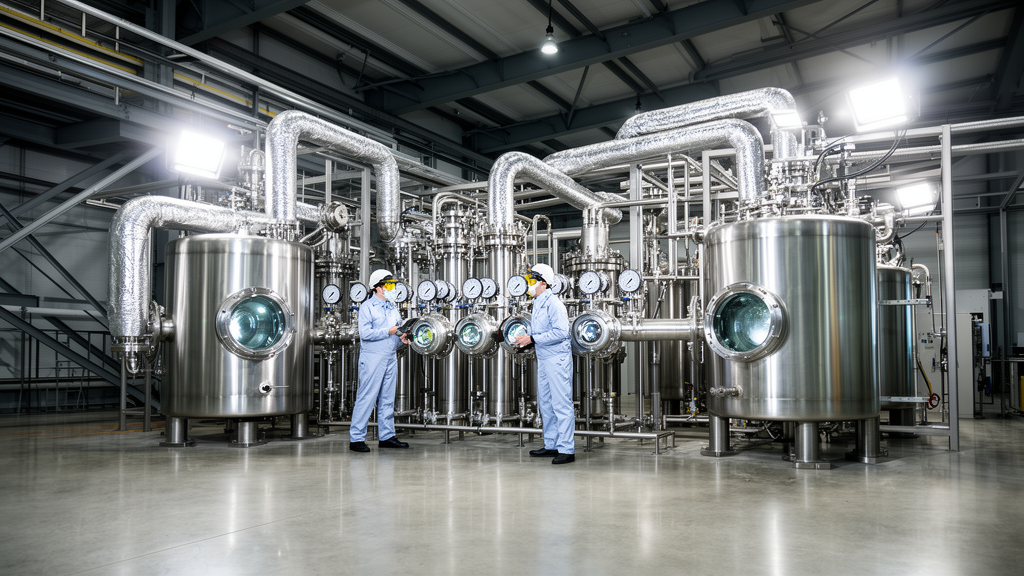
PeroCycle, a spin-out company from the University of Birmingham, has announced the signing of a Memorandum of Understanding with Glass Futures Ltd to develop an advanced scaling platform for closed-loop carbon recycling technology. This innovative approach seeks to reduce carbon emissions across foundational industries, particularly in steelmaking, by as much as 90%.
This strategic collaboration will lead to the construction and operation of a two-tonne pilot reactor in St Helens, Merseyside, with a series of real-world testing activities planned throughout 2027. The new recycling technology employs a perovskite catalyst capable of converting carbon dioxide into carbon monoxide at significantly lower temperatures than traditional methods. The resulting carbon monoxide can then be recycled back into various industrial processes, serving as a valuable feedstock.
The previous efficacy of the perovskite catalyst was established through laboratory prototypes designed under optimal conditions. The forthcoming trials aim to further evaluate, refine, and enhance the catalyst and reactor’s performance under typical high-temperature operational conditions, utilizing clean and diverse industrial gas supplies. The ability to produce the catalyst on-site using Glass Futures’ material blending and furnace facilities represents a significant step in this collaboration.
According to PeroCycle’s Chief Executive Officer, the partnership will meticulously assess the formulation and structure of the catalyst during these trials. David Coleman, Chief Executive Officer of University of Birmingham Enterprise, highlighted the importance of conducting these tests under real-world conditions, which will help develop robust evidence to support future commercial adoption of the technology.
Moreover, PeroCycle has garnered international recognition by securing a place on the Cleantech 50 to Watch list for 2026. This annual compilation identifies pioneering innovations that tackle pressing environmental issues. Traditionally focused on early-stage ventures in domains such as artificial intelligence energy demands and critical mineral supply security, the 2026 assessment broadened its criteria to encompass additional industrial sectors. In this context, PeroCycle distinguished itself as one of only three companies globally recognized for its efforts in decarbonizing heavy industry, and notably, it is the only British enterprise acknowledged in this category. Grant Budge is scheduled to present at the Cleantech Forum Europe Innovation Showcase on November 18, 2026, in Barcelona, Spain.
Justin Kelly, Chief Executive Officer of Glass Futures, remarked on the organization’s mission to support innovative companies in transitioning their developmental projects from academic laboratories to industrial-scale implementations. By facilitating demonstrations that convert industrial waste streams into usable fuels, Glass Futures aims to promote decarbonization efforts across energy-intensive manufacturing sectors, extending beyond the glass industry. A crucial focus of this collaborative effort is to establish dependable manufacturing systems that can efficiently scale catalyst production from small laboratory quantities to pilot-scale amounts.
As the initiative unfolds, it holds the potential to not only address significant carbon emissions in industries such as steelmaking but also to pave the way for innovative recycling methodologies that align with global sustainability efforts.