
Student loan collections resume: Key information for borrowers to prevent wage garnishment and protect credit.
Starting on May 5, the U.S. Department of Education is set to resume debt collection activities for federal student loans that remain in default, marking the first such action in five years. This decision impacts nearly 10 million borrowers, translating to roughly one in four federal student loan holders who could soon face severe financial repercussions, including wage garnishments and the loss of tax refunds.
With the resumption of loan collections, borrowers are urged to familiarize themselves with repayment options to prevent further credit damage and to understand the potential for loan forgiveness. In states like Pennsylvania, New Jersey, and Delaware, over three million federal student loan borrowers collectively owe nearly 0 billion, with the average loan amount in Pennsylvania exceeding ,000, according to data from the Student Borrower Protection Center.
This situation emphasizes the critical importance of understanding available repayment plans, particularly as the borrower landscape shifts. Key among these options are income-driven repayment (IDR) plans, which adjust monthly payment amounts based on the borrower’s income and household size. Under such plans, payments can reduce to as low as [or_text model=”openai/gpt-4o-mini” prompt=”Rewrite this article in the professional, objective style of top newspapers like NY Times, expanding to at least 350 words. Ensure it’s SEO-friendly, plagiarism-free, and replace the source with “Media News Source” and dont mention author name. Do not include quotation marks or any code in the output.:
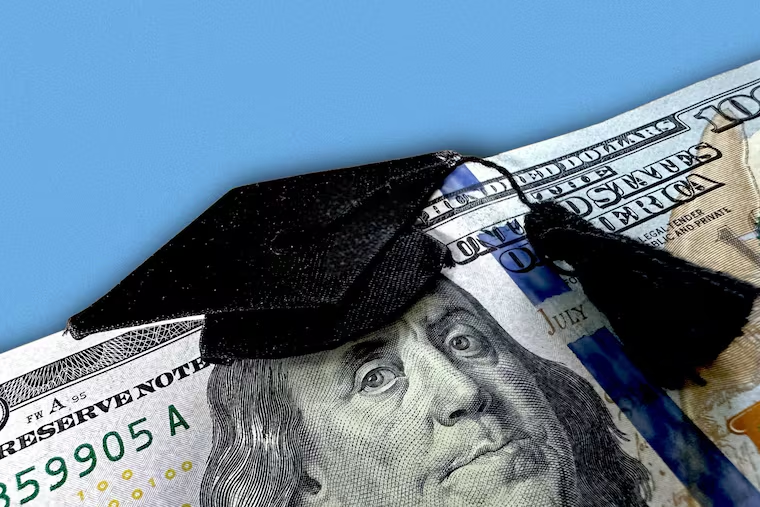
Starting Monday, May 5, the U.S. Department of Education will resume debt collections on federal student loans in default — for the first time in five years.
Nearly 10 million Americans are currently in or approaching default, federal officials say, meaning almost one in four federal student loan borrowers could soon face wage garnishment or lost tax refunds if they don’t act.
That makes now a critical time to understand repayment options and avoid damaging your credit or missing out on future loan forgiveness.
In Pennsylvania, New Jersey, and Delaware, more than 3 million federal student loan borrowers hold nearly $120 billion in debt. The average borrower in Pennsylvania owes more than $40,000, according to the Student Borrower Protection Center.
This guide breaks down what the restart of collections means, outlines federal repayment plans — including the now-paused SAVE plan — and offers help from national and local organizations.
What does the return of collections mean?
If a borrower misses monthly payments for 90 days, their loan servicer reports them as delinquent to credit bureaus, which can lower their credit score. After 270 days of nonpayment, the loan enters default — a status that can make it harder to get approved for credit cards, car or home loans, and often leads to higher interest rates. Most negative marks remain on a credit report for up to seven years.
Once in default, the Education Department can garnish wages, withhold tax refunds or Social Security payments, and take other aggressive collection actions.
Income-driven repayment (IDR) plans
For borrowers struggling to make payments, income-driven repayment (IDR) plans can lower monthly bills based on income and household size — sometimes to as little as $0.
“Even if you’re in delinquency and you’ve missed a couple of payments, you can still apply for IDR,” said Aissa Canchola Bañez, policy director at the Student Borrower Protection Center. “If you are very low income, IDR options, currently as they stand, can provide a borrower with as low as a $0 monthly payment.”
These plans require borrowers to recertify annually with updated income and household information. They offer two main benefits:
-
Lower payments: Monthly bills are typically 10% to 20% of a borrower’s discretionary income — the amount left after covering essentials like rent and utilities.
-
Loan forgiveness: After making consistent payments for 20 to 25 years (depending on the plan), any remaining loan balance may be forgiven.
Borrowers can estimate payments for each plan using the Education Department’s Loan Simulator at studentaid.gov/loan-simulator.
What’s happening with the SAVE plan?
The SAVE plan, launched in 2023, offered the most generous repayment terms: lower monthly bills, no interest growth if payments were made, and quicker forgiveness.
But in 2024, lawsuits filed by Republican-led states halted its full rollout. While borrowers currently in the SAVE plan are in general forbearance until fall 2025 — meaning no payments are required and interest isn’t growing — that time does not count toward loan forgiveness or Public Service Loan Forgiveness (PSLF).
To get credit toward forgiveness, SAVE enrollees may want to switch to another IDR plan.
What other IDR plans are available?
-
10% of discretionary income
-
10% if loans taken after July 1, 2014 (20-year forgiveness)
-
15% if before July 1, 2014 (25-year forgiveness)
Income-Contingent Repayment (ICR):
-
20% of discretionary income
-
Forgiveness after 25 years
-
Forgiveness after 20 years
Note: Due to a recent backlog, IDR applications may take time to process.
Is loan forgiveness still available?
Yes — loan forgiveness is still available under several income-driven repayment (IDR) plans, including PAYE, IBR, and ICR, after 20 to 25 years of qualifying payments. The SAVE plan is currently paused and its future remains uncertain.
Here’s a breakdown of forgiveness timelines:
-
IBR: 20 years if loans were borrowed after July 1, 2014; 25 years if borrowed before.
-
ICR: 25 years.
-
PAYE: 20 years.
-
PSLF: Forgiveness after 120 qualifying monthly payments (typically 10 years) for borrowers working in public service jobs.
Should I switch IDR plans now that SAVE is paused?
It depends. Each borrower’s situation is different.
“If you are a borrower who is trying to make progress towards loan forgiveness, it could be the right option for you to explore getting on one of the other IDR plans,” Canchola Bañez said. But for others, staying in SAVE’s general forbearance — which pauses payments and interest through fall 2025 — might make sense.
Just note: Time spent in SAVE’s forbearance does not count toward forgiveness, including Public Service Loan Forgiveness. If you’re hoping to qualify for PSLF, you may need to switch plans and consolidate into a Direct Loan if you haven’t already.
What if I need help navigating repayment?
Kristin McGuire, executive director of Young Invincibles, said the first step is reaching out to your federal loan servicer — the company that manages your student loan account.
But be prepared: “Borrowers experience extended wait times with federal loan servicers,” McGuire said. “It’s very difficult to get in touch with these people.”
Still, it’s worth trying. And if you’re in Philadelphia, there are local organizations that can help with financial guidance and student loan questions.
What about Public Service Loan Forgiveness?
The PSLF program forgives federal student loans after 10 years (120 qualifying monthly payments) for borrowers who work full time at qualifying government or nonprofit jobs.
To qualify, borrowers must:
-
Have federal Direct Loans (or consolidate into one)
-
Be in a qualifying repayment plan (IDR or 10-year Standard)
-
Work full time at a qualifying employer
-
Make 120 monthly payments (not necessarily consecutive)
Time spent in SAVE’s general forbearance does not count toward PSLF. If you’re aiming for PSLF, consider switching out of SAVE and ensuring your loans are consolidated into Direct Loans.
Where to get help with your federal student loans
Federal servicers are the go-to for repayment issues — but long wait times and communication issues are common.
Here are other national and Philly-based resources that can help:
National resources
Federal Student Aid (StudentAid.gov)
The official federal site for loan information and repayment tools.
Student Loan Borrower Assistance
Run by the National Consumer Law Center. Provides info, not one-on-one help.
🌐 studentloanborrowerassistance.org
Student Borrower Protection Center
Advocacy group offering research and legal support (not personal casework).
Philadelphia resources
Free legal aid for low-income Philadelphians, including help with student loans.
🌐 clsphila.org, 📞 215-981-3700,📍1424 Chestnut St., Philadelphia Pa. 19102
City-run centers that offer general financial guidance.
🌐 phila.gov/programs/financial-empowerment-centers, 📞 855-346-7445,📍Various locations
One-on-one financial counseling. May not offer detailed loan help, but can assist with budgeting and planning.
🌐 clarifi.org, 📞 215-563-5665,📍1635 Market St., 5th Floor, Philadelphia, Pa. 19103
“], enabling financially strained borrowers to maintain compliance without undue pressure. Borrowers in delinquency can still apply for these plans, which require annual recertification of income details.
The recently introduced SAVE plan aimed to provide generous repayment terms, such as no interest accrual for payments made and expedited forgiveness timelines. However, complications arising from lawsuits initiated by several Republican-led states have halted its full implementation. As a result, those enrolled in SAVE are currently in a general forbearance period that extends through fall 2025, during which payments are not required, though this time will not contribute toward loan forgiveness.
For those contemplating whether to switch from the suspended SAVE plan to another IDR option, personal circumstances will dictate the best course of action. While some borrowers may benefit from exploring other IDR plans—especially those with aspirations of reaching loan forgiveness through consistent payments—others may find it more advantageous to remain in forbearance for the interim.
As borrowers navigate the complexities of student loan repayment, reaching out to federal loan servicers is a vital first step, though they are often met with long wait times and communication difficulties. Alternative resources are available for those in Philadelphia, including local organizations that offer financial guidance and support regarding student loans. For example, Community Legal Services provides free legal assistance related to student loans for low-income residents, complementing city-operated Financial Empowerment Centers that focus on general financial advice.
As the student loan landscape evolves, affected individuals are reminded of the importance of taking proactive steps to understand their options and access available resources, particularly as they face the impending collection process for defaulted loans.


