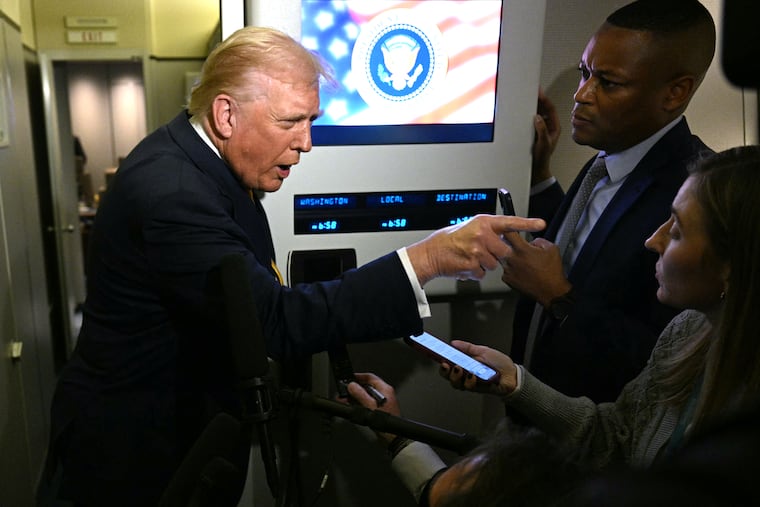
Trump criticizes former Philadelphia reporter during discussion about Jeffrey Epstein.
President Donald Trump is facing a wave of controversy following a recent confrontation with journalist Catherine Lucey, a Bloomberg White House correspondent, regarding files related to Jeffrey Epstein. The incident transpired during a press interaction aboard Air Force One, where Lucey sought to inquire about the administration’s ongoing refusal to disclose these controversial files.
As Lucey attempted to pose her question, she was abruptly interrupted by Trump. When she suggested that if there was nothing incriminating in the files, it would be reasonable for their release, Trump reacted scornfully, instructing her to be quiet and labeling her in a derogatory manner. The exchange has since sparked significant backlash, particularly among media circles, and has raised concerns about the treatment of female journalists in the press.
Lucey has not yet publicly commented on the incident, and her employer, Bloomberg, issued a statement defending the critical role of White House reporters in holding power to account. The statement underscored the importance of asking difficult questions vital to public interest, emphasizing that these journalists strive to report fairly and accurately.
In reaction to Trump’s remarks, criticism has flowed from various sectors of the media. CNN anchor Jake Tapper described the president’s comments as appalling, while former Fox News anchor Gretchen Carlson labeled them degrading. The Atlantic’s McKay Coppins remarked on the inappropriate nature of Trump’s conduct, comparing it to behavior that would be deemed unacceptable in children.
A White House official attempted to defend the president’s actions, alleging that Lucey had engaged in unprofessional behavior during the exchange, though no specific details were provided to substantiate this claim.
The implications of the incident gained further prominence as footage of the interaction began circulating widely on social media platforms, drawing public ire. This incident is not an isolated one, as Trump has a documented history of making disparaging remarks toward female journalists. Over the years, he has referred to female reporters using derogatory terms, heightening concerns over his treatment of women in the media.
Furthermore, Trump has also recently faced criticism for disparaging another journalist, ABC News’s Mary Bruce, who asked him about the Epstein files during a meeting with Saudi Crown Prince Mohammed bin Salman. His remarks during that exchange, in which he labeled her a “terrible person and a terrible reporter,” reflect a continuing pattern of hostility toward members of the press.
Until recently, Trump had staunchly opposed releasing the Epstein files, describing efforts to relieve them as a “Democrat hoax.” However, he appears to have shifted his stance, stating on Air Force One that the administration has “nothing to hide.” The urgency of public scrutiny surrounding these files has accelerated following the House of Representatives’ recent passage of the Epstein Files Transparency Act. This act received overwhelming bipartisan support, passing with a vote of 427-1 and now moving to the Senate for further consideration.
As the discourse surrounding Trump’s comments and the Epstein files continues, the case underscores ongoing tensions between the media and the presidency, particularly regarding transparency and accountability in government actions.