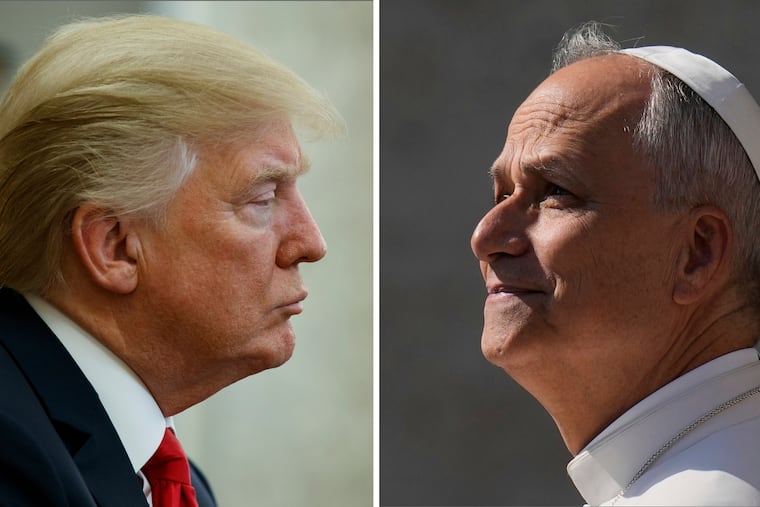
Trump questions Pope Leo’s relevant authority in recent statements.
In recent developments surrounding the discourse on the role of the Catholic Church in societal issues, tensions have emerged between the Vatican and certain political figures in the United States. Prominent voices within the current administration have suggested that Pope Leo XIV should refrain from involvement in matters of politics, science, and economics. This perspective, articulated by notable figures such as President Donald Trump and Secretary of State Marco Rubio, argues that the pontiff’s authority ought to be confined to issues of faith and morality.
This recent discourse raises fundamental questions about the intersection of faith and public life. Individuals such as Vice President J.D. Vance have publicly warned the pope to maintain a narrow focus, underscoring a growing sentiment that religious leaders should limit their influence on temporal matters. In this context, the argument posits that the Catholic Church’s teachings should serve as a moral compass only in religious contexts, rather than inform broader societal and political frameworks.
As a lifelong Catholic, scientist, and theologian, one might ponder the implications of such demarcation. The process of decision-making in scientific research is inherently complex and multifaceted, often influenced by ethical considerations that interweave with personal beliefs. When faced with choices such as the development of life-saving drugs versus potentially harmful weapons, many individuals find that their moral frameworks, shaped by faith, play a crucial role in guiding their actions.
The division proposed by political leaders seems to suggest that moral considerations should be shelved in secular arenas. However, for many, including devout Catholics, such a dichotomy poses a challenge. Faith is not merely a compartmentalized activity; it shapes values, perspectives, and decisions across all areas of life. The teaching of the Church emphasizes that individual conscience is paramount and should remain informed by a lifetime of disciplined reflection on values, experiences, and faith.
Despite the call for separation, biblical principles assert the importance of recognizing the dignity of every human life. The teachings encourage adherents to pursue social justice, compassion, and empathetic engagement with those in need, irrespective of their circumstances. As Pope Leo XIV reiterates his commitment to preaching the Gospel, a call for action emerges that transcends traditional boundaries between church and state.
The discourse around the role of conscience in personal and political life is complex, yet inherently vital. It suggests that rather than abandoning moral guidance in public endeavors, individuals are invited to engage fully with their beliefs to navigate the complexities of contemporary challenges. Ultimately, the convergence of faith and public life is not a matter of restricted lanes but rather an integrated journey guided by conscience and moral inquiry. The ongoing dialogue around these themes is sure to shape the future intersections of faith and public policy in the United States and beyond.
This commentary reinforces the idea that faith informs values that are essential for shaping a just society, calling for an authentic interplay between religious conviction and civic responsibility.