Trump’s Immigration Crackdown Faces Opposition in New Jersey Parking Lot Protest
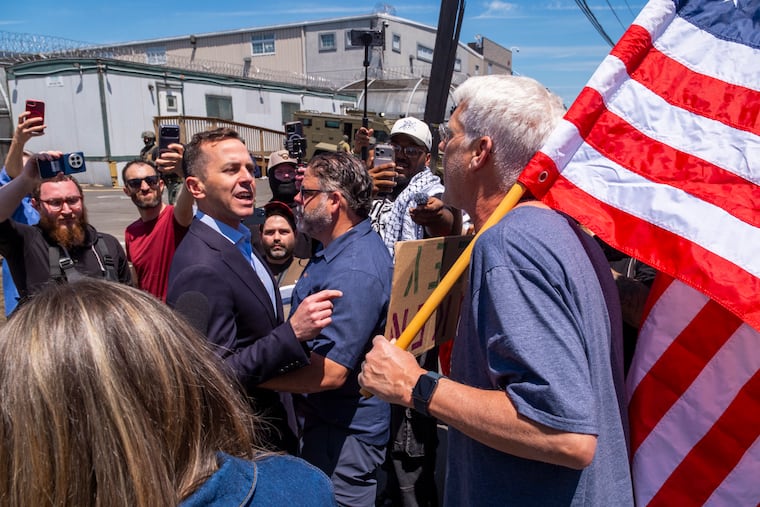
In Newark, New Jersey, a significant protest unfolded on Tuesday morning, with demonstrators gathering at dawn to voice their concerns regarding the living conditions at Delaney Hall, a federal detention center managed by Immigration and Customs Enforcement (ICE). The visual landscape was marked by a stark juxtaposition: activists wielding cardboard signs faced off against a heavily armed federal presence, including agents outfitted in helmets and flak vests, amidst a simmering tense atmosphere.
For five consecutive days, activists have maintained a heightened presence outside Delaney Hall, which has become emblematic of the immigration enforcement policies enacted during the previous Trump administration. A series of reports have emerged from detainees alleging deplorable conditions, including spoiled food and inadequate medical care. These grievances have been voiced by both detainees and their families, leading to growing expressions of concern from Democratic officials in New Jersey.
On this particular Tuesday, emotions peaked among the demonstrators. Some activists expressed their anger towards the federal agents, while others displayed visible distress, underscoring the often emotional nature of such protests. The nearby Passaic River added to the grim ambiance with its offensive odor, reminiscent of untreated waste.
One volunteer, Rebecca Brunner, associated with an organization called the Radical Hospitality Zone, reflected on her commitment to supporting families affected by the ICE detention system. Her statement highlighted the impending escalation of tensions, mirroring the sentiments of many involved.
In response to the mounting criticism, the Department of Homeland Security issued a statement categorically denying claims of inhumane treatment at Delaney Hall. They asserted that reports of a hunger strike were erroneous and urged detainees to consider self-deportation. The agency contended that the standard of care provided at ICE facilities exceeds that of many U.S. prisons.
However, the American Civil Liberties Union of New Jersey countered this narrative, issuing its own affirmation that a hunger strike had indeed taken place. The organization noted that various detention facilities throughout the country have witnessed similar forms of resistance among detainees.
Political figures, including Governor Mikie Sherrill and Senator Andy Kim, have called for the closure of Delaney Hall, expressing deep concerns over its operational status following its reopening last year. The protests outside the facility have varied in size, drawing anywhere from dozens to over a hundred participants, met by federal agents prepared for confrontation.
Recent clashes between protesters and law enforcement resulted in the use of pepper spray and crowd control measures, escalating the situation further. Demonstrators voiced concerns not only for those within the detention center but also for the conduct of federal agents outside its gates, highlighting the dual nature of the ongoing conflict.
As protests continue and voices grow louder in opposition to the federal government’s immigration enforcement tactics, the situation at Delaney Hall increasingly draws attention from the broader community, reflecting a growing national discourse surrounding immigration policies. Abdur Yasin, a firefighter from West Orange, encapsulated the sentiments of many involved, urging for dignity in the treatment of those detained.
The events unfolding in Newark exemplify a critical moment in the ongoing dialogue regarding immigration enforcement and human rights, igniting responses that resonate far beyond the streets of New Jersey.