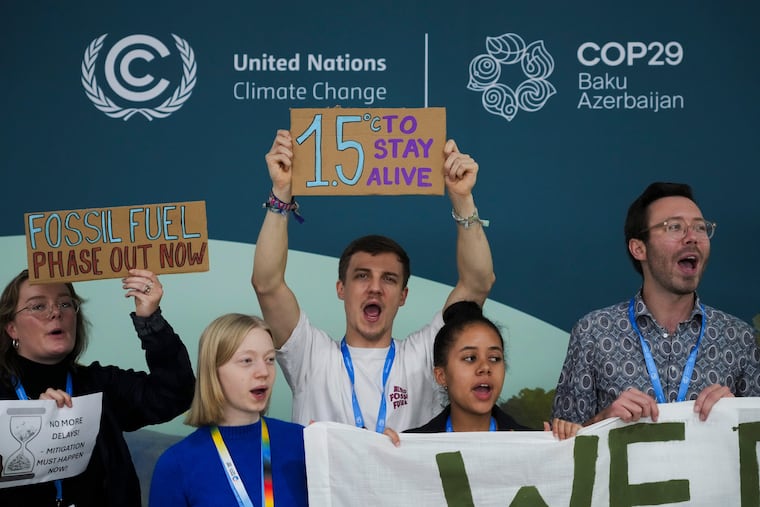
U.N. warns that global climate targets will be missed and emphasizes the need to reverse warming trends.
The United Nations has issued a stark warning about the global climate crisis, indicating that the world has failed to achieve its goal of limiting global warming to 1.5 degrees Celsius above preindustrial levels. This assessment, presented in a comprehensive 141-page report, outlines a challenging new objective for addressing climate change, which signals a troubling trajectory for the planet.
A decade ago, countries around the globe committed to the Paris Agreement, aiming to restrict temperature increases to “well below” 2 degrees Celsius, with a more ambitious target of 1.5 degrees Celsius, equivalent to approximately 2.7 degrees Fahrenheit. However, the latest U.N. report cautions that the planet is expected to exceed this critical threshold, necessitating a shift in focus toward mitigating the extent of temperature overshoot and working to recover from it.
Despite notable advancements in renewable energy sources such as wind and solar power, the global reliance on fossil fuels, namely oil, gas, and coal, remains prevalent. These energy sources continue to contribute to rising levels of carbon dioxide in the atmosphere, which has already resulted in an average global temperature increase of about 1.4 degrees Celsius. This warming is manifesting in more extreme weather patterns, droughts, floods, and other threats to biodiversity and human health.
The report outlines that addressing this climate crisis will be an arduous task, likely requiring massive carbon dioxide removal efforts on an unprecedented scale. This could involve extensive reforestation initiatives and the development of innovative technologies designed to cleanse the atmosphere of excess carbon—many of which are still in the experimental phases.
Even under optimistic scenarios, the Earth could continue to warm for decades, if not centuries, before stabilizing at more bearable levels. Some changes, such as glacial melting and rising sea levels, have already reached a point of no return.
António Guterres, the U.N. Secretary-General, has previously acknowledged that surpassing the 1.5 degrees Celsius threshold is virtually inevitable. The report emphasizes the narrow margin available for employing strategies to manage temperature overshoot effectively. Specifically, to maintain temperatures at or below 1.5 degrees Celsius by the century’s end, peak warming would need to be limited to 1.8 degrees Celsius (3.2 degrees Fahrenheit)—a target that many climate scientists deem improbable.
In light of current policies and trends, projections suggest that the globe may warm by as much as 2.6 degrees Celsius (4.7 degrees Fahrenheit) by century’s end. Experts warn that without significant political will and urgency to address climate change, the world will fail to meet its climate targets, posing severe risks to both the environment and human society.
The U.N. report emphasizes that failure to act decisively could lead to irreversible damage, as seen in recent extreme weather events worldwide. Calls for action resonate strongly within scientific and environmental communities, driving the message that time is of the essence in the global fight against climate change.