Philadelphia site of ICE arrest marked with fake historic sign
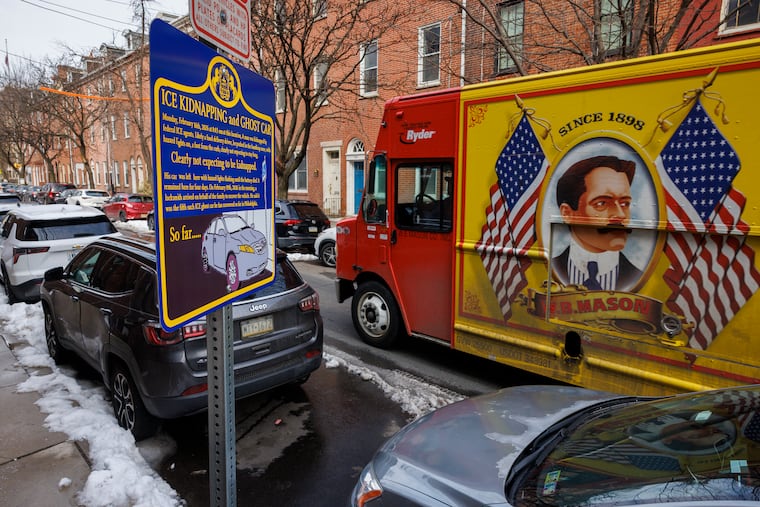
In the heart of Philadelphia’s Northern Liberties neighborhood, a striking blue-and-yellow marker has emerged, one that deviates from the traditional commemorative signs found throughout Pennsylvania. Rather than honoring a historical figure or event, this marker draws attention to a recent and controversial incident involving the United States Immigration and Customs Enforcement (ICE).
On February 16, an ICE operation targeted Abdulasen Nazarkhudoev, a Gopuff delivery driver who was apprehended while making a routine drop-off. The delivery vehicle was subsequently left parked, hazard lights flashing, for several days in a handicapped space near the intersection of Fairmount Avenue and Fifth Street. The scene, which has since garnered public intrigue and concern, became a focus for local artists.
This particular marker, however, is an unofficial art installation created by local artists Huston West and Emeyewhisky. Their intent was to shed light on the lives affected by such arrests, emphasizing the shock and disruption that often accompany ICE actions. The sign is labeled “ICE Kidnapping and Ghost Car,” with the latter descriptor reflecting the phenomenon of vehicles abandoned by individuals taken into custody by immigration authorities.
The term “ghost car” is borrowed from “ghost bikes,” memorials for cyclists who have tragically lost their lives on the road. West explained that the project is a heartfelt response to the incident, suggesting a broader social consciousness regarding the actions of immigration enforcement. The artists were driven by curiosity about Nazarkhudoev’s fate and how the incident has irrevocably altered his life.
Federal authorities, including ICE, have countered the label of “kidnapping,” asserting that their operations are lawful and aimed at apprehending individuals illegally residing in the U.S. In Nazarkhudoev’s case, ICE officials reported that he was unlawfully present in the country, claiming him to be a Russian citizen.
Following his arrest, Nazarkhudoev was taken to an ICE facility in Philadelphia. Legal proceedings ultimately led to his release, with a judge noting that he had entered the U.S. in 2022 and was in pursuit of asylum, during which time he had obtained a work permit and a driver’s license.
The public response to the installation has been mixed, reflecting deep-seated divisions within the community regarding immigration policy and enforcement. Some local residents expressed support for the artist’s initiative, while others defended ICE’s actions, questioning the portrayal of the incident as kidnapping.
The phenomenon of “ghost cars” has emerged as a poignant reminder of the impact of immigration enforcement actions, not just on individuals but also on communities. Such installations aim to create a dialogue about the implications of these arrests, challenging residents to confront the realities faced by immigrants in the U.S. As the debate continues, the installation stands as a symbol of the ongoing struggles surrounding immigration policy in America.
Media News Source