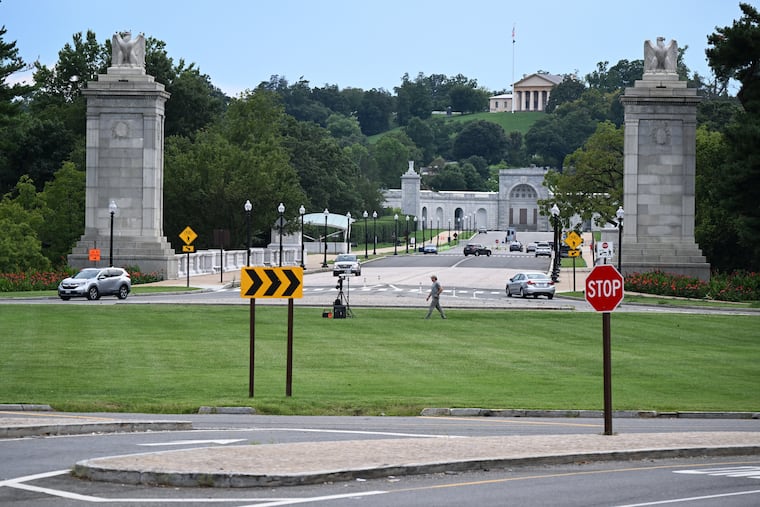
Trump announces plans for a 250-foot arch to serve as a military complex for drones and snipers.
In a recent development, President Donald Trump has announced a controversial shift in the purpose of his proposed 250-foot triumphal arch near Arlington National Cemetery. Initially intended as a commemorative structure, the project will now function as a military complex equipped with drones, snipers, and substantial amounts of ammunition, according to Trump’s statement on Truth Social, made at the behest of the U.S. military for national security purposes.
The proposed “Military Complex/Triumphal Arch” is designed to accommodate a range of military assets, including a rapid deployment capability for drones and snipers stationed on the roof and plaza. Trump asserted that the facility will be unparalleled worldwide, a claim that raises eyebrows given the project’s intended location adjacent to one of the most significant military cemeteries in the United States.
This shift in purpose comes amidst significant opposition from veterans’ groups, historic preservationists, and local residents. Critics argue that the towering structure would overshadow Arlington Cemetery and disrupt the historical view of the Lincoln Memorial and other iconic sites nearby. The National Capital Planning Commission has previously indicated that the arch would serve as a visitor destination, complete with an observation deck, but the new military focus has not been previously discussed during the months of federally mandated reviews.
Construction is slated to begin as early as November, a timeline that has prompted scrutiny. The White House and the Department of the Interior, which oversees the area where the structure will be built, have not responded to requests for comment regarding Trump’s announcement. This lack of clarity raises questions about how the project will navigate federal preservation protocols, particularly if its stated purpose has fundamentally changed.
Many preservationists are now contending that the redesigned proposal may necessitate additional federal reviews, given its potential implications for the surrounding environment. Concerns have also emerged about the feasibility of establishing a military complex in such a heavily trafficked area, particularly considering proximity to Reagan National Airport. Local representatives have voiced skepticism, with one congressman labeling the proposal—a drone launching site situated in a landing path for an airport—as “stupid, dangerous, and unworkable.”
As the situation evolves, legal challenges against the project continue. U.S. District Judge Tanya S. Chutkan is currently evaluating a case that centers on whether construction should be halted pending a thorough review of its impacts on the area. Past rulings have cautioned the administration against hasty construction without proper approvals.
Trump’s administration has cited perceived national security needs to propel this project forward, paralleling arguments made for other controversial constructions deemed similarly justified by shifting justifications. The ongoing litigation emphasizes the complexity of balancing infrastructure development with historical preservation in a region of considerable national significance.