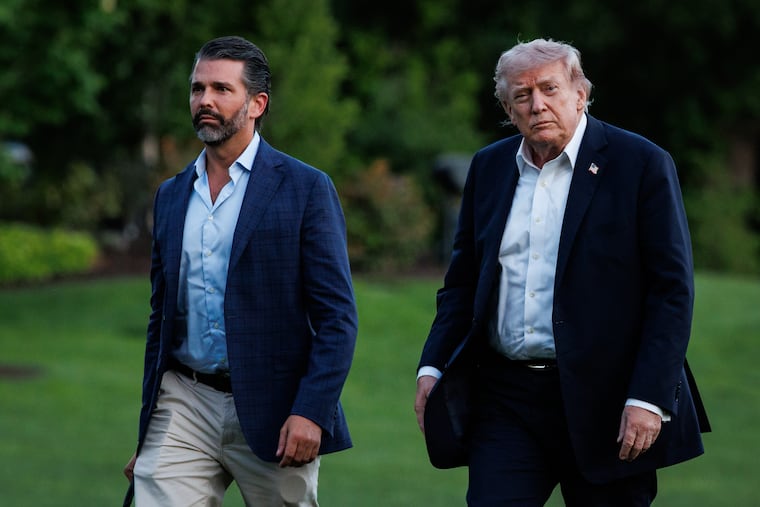
Trump and his sons make significant investments in the AI sector while declining to slow down their involvement.
President Donald Trump’s business interests have increasingly intersected with developments in artificial intelligence (AI), as evidenced by a recent analysis of his financial disclosures and corporate activities. Despite growing calls for a balanced approach to AI development, Trump has positioned himself as a proponent of rapid technological advancement, fueled by relationships with influential figures in the tech industry, including venture capitalist David Sacks, Nvidia CEO Jensen Huang, and Meta CEO Mark Zuckerberg.
The urgency surrounding AI development is not just a matter of policy for Trump; it also has financial implications for him personally. Trump has not placed his assets in a blind trust, unlike most prior presidents, and he has continued trading stocks while in office, thereby raising potential conflicts of interest. The Trump family has significant investments in sectors that are benefiting from the AI boom, such as companies involved in computing infrastructure and power generation.
A former director of the Office of Government Ethics remarked on the unparalleled nature of Trump’s financial dealings, highlighting the importance of public trust in presidential conduct. White House spokesperson Davis Ingle countered this perspective, asserting that Trump’s investments are managed independently, with no direct involvement from him or his family.
The Trump family’s financial disclosures indicate approximately 30,000 transactions since Trump assumed office, many related to companies supplying essential components for AI technologies. Investments in firms like Dell Technologies, Micron Technology, and GE Vernova illustrate how intertwined his financial interests are with the expanding AI sector.
Moreover, businesses associated with the Trump family are actively engaging in various AI-related initiatives. The Trump Media & Technology Group (TMTG), the parent company of Truth Social, is exploring mergers and partnerships aimed at capitalizing on the AI market. Additionally, Trump’s sons, Donald Trump Jr. and Eric Trump, are backing investments in multiple AI ventures through their investment firms.
As AI development continues to provoke debate among lawmakers, researchers, and industry leaders, concerns grow regarding the rapid pace of innovation and its societal implications. Notably, prominent tech figures have recently warned of the potential dangers associated with accelerated AI advancements.
Looking ahead, Trump’s portfolio is likely to be affected by his governmental decisions, particularly regarding the AI sector. As the midterm elections approach, AI as a political issue presents both challenges and opportunities for the current administration, amid public unease about the consequences of the technology’s rapid evolution.
The volatility in AI-related stocks further complicates this landscape, as recent market trends have showcased sharp declines in AI stock prices following critiques of rapid development. With increasing scrutiny over his dual role as a government leader and a businessman linked to AI, the trajectory of Trump’s financial and political future remains uncertain, particularly as protections against potential conflicts of interest are debated among the public and lawmakers.
Given this complex intersection of wealth, technology, and governance, the implications of Trump’s investments in AI may reverberate well beyond financial markets, potentially influencing national policy at a critical juncture in technological advancement.