
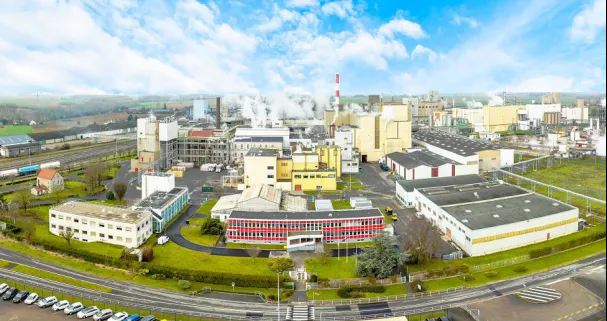
Michelin ResiCare has announced the establishment of a new industrial production line dedicated to the creation of a revolutionary bio-based molecule, part of its ambitious DragonFly project, situated at Ajinomoto’s industrial facility in Nesle, France. This initiative represents a significant investment in sustainable chemistry and is poised to position France as a leader in the bio-based production sector.
The DragonFly project aims to enhance the industrialization of fermentation processes, focusing on producing bio-based aromatic monomers essential for Michelin ResiCare’s innovative resin formulations. With the completion of this production line projected for early Q2 of 2027, the technology will undergo validation in real-world conditions, marking a pivotal point in the company’s commitment to environmentally friendly and safer chemical production.
Ajinomoto and Michelin ResiCare’s collaboration, which was formalized in April 2026, underscores the potential of the DragonFly project to serve as a cornerstone in the production of bio-based molecules. This partnership is further complemented by another initiative, Cerisea, which seeks to create Europe’s first 5-HMF production value chain, thereby strengthening the region’s bio-based industrial capabilities.
The strategic location in Nesle capitalizes on existing industrial infrastructure while drawing on Ajinomoto’s expertise in fermentative technology. The fermentation process employed within the DragonFly project utilizes a specialized microorganism strain developed through collaboration with Alderys, a subsidiary of the Givaudan Group. This methodology has been previously tested and validated on an industrial scale through the BioImpulse project. Remarkably, this process has the potential to reduce greenhouse gas emissions by as much as 96% compared to traditional petrochemical sources.
The applications for these bio-based resins are diverse, extending to sectors such as construction, electronics, automotive, aerospace, and beyond, showcasing the versatility and sustainability of the new materials being developed. The DragonFly initiative, therefore, not only signifies a key step forward for Michelin ResiCare but also contributes to the broader objectives of enhancing European industrial sovereignty over critical raw materials.
The French government has invested in this project as part of its France 2030 investment strategy, managed by ADEME (the French Agency for Ecological Transition). Through such initiatives, France is setting a standard for sustainable industrial practices while fostering innovation in the bio-based chemistry sector.